
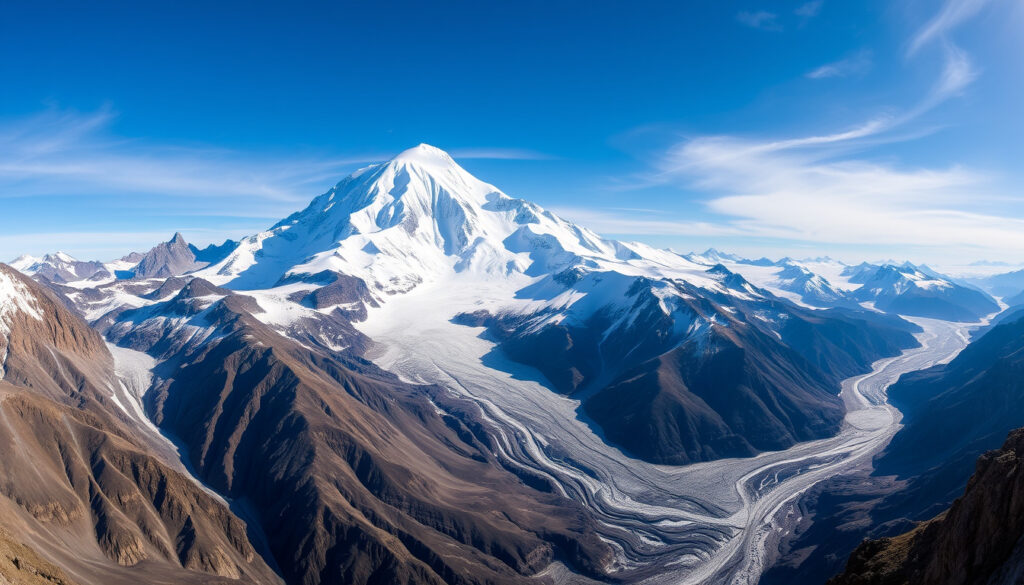
Canada’s highest peak draws far fewer climbers than Denali or Everest, yet those who attempt Mount Logan step into one of the most remote and demanding alpine environments on the continent. This guide breaks down what makes the mountain so challenging, how it compares to Denali, and what you need to know before planning an expedition.
Height: 5,959 m (19,551 ft) ·
Location: Yukon, Canada ·
First ascent: 1925 ·
Named after: Sir William Edmond Logan
Quick snapshot
- Mount Logan is Canada’s highest peak at 5,959 m / 19,551 ft (Mountain Madness expedition page)
- First ascent in 1925 by a party from the Alpine Club of Canada (Parks Canada)
- Located in Kluane National Park, Yukon (Parks Canada)
- Second-highest peak in North America after Denali (Wikipedia)
- Annual climber counts vary widely — estimates range from a few dozen to under 100 per year
- Exact expedition cost depends on guiding company, season, and logistics (no fixed published price)
- Whether the King Trench route qualifies as “technical climbing” is debated between operators
- Growing interest in guided packages from operators like Mountain Madness and Summit Mountain Guides
- Climate change affecting glacier conditions on the King Trench route (Mountain Madness)
Six key facts at a glance — from elevation to naming history.
| Label | Value |
|---|---|
| Height | 5,959 m (19,551 ft) |
| Location | Yukon, Canada |
| Mountain Range | Saint Elias Mountains |
| First Ascent | 1925 |
| Named After | Sir William Edmond Logan |
| Nearest City | Haines Junction, Yukon |
Where in Canada is Mount Logan?
Mount Logan rises in the southwest corner of the Yukon Territory, deep inside Kluane National Park and Reserve — a UNESCO World Heritage site known for massive ice fields and peaks. The mountain is the crown jewel of the Saint Elias Mountains, a coastal range that stretches from southeastern Alaska into Canada.
What mountain range is Mount Logan in?
The Saint Elias Mountains are part of the larger Pacific Coast Ranges. They contain four of the six highest peaks in Canada, with Logan at the top. Unlike the jagged Rockies, the Saint Elias Mountains are defined by enormous ice sheets and valley glaciers that make access a serious logistical challenge.
Getting to base camp alone requires a bush plane or ski plane from Haines Junction — there is no road (Parks Canada).
Mount Logan sits within a national park, but reaching it costs more time and money than flying to Everest base camp. The remote setting is both its appeal and its greatest barrier.
The implication: access defines the entire expedition before a single step is taken on the mountain.
Is Mount Logan harder than Denali?
This is the question that divides mountaineers. Both are high, cold, and serious, but they demand different skill sets.
How difficult is Mount Logan?
Mountain Madness calls Logan “a notch above Denali in seriousness.” Their trip page lists prerequisites: altitude experience above 14,000 ft, solid glacier travel skills, winter camping experience, and excellent physical fitness. Climbers haul loads up to 60 lb on sleds and skis, face steep snow and ice slopes up to 50 degrees, and endure summit days exceeding 12 hours.
Denali is taller (6,190 m vs 5,959 m) but has more established routes, fixed camps, and a shorter approach. Logan’s remoteness means that any emergency response is hours or days away.
The pattern: higher elevation favors Denali; technical complexity and isolation favor Logan.
| Factor | Mount Logan | Denali |
|---|---|---|
| Elevation | 5,959 m (19,551 ft) | 6,190 m (20,310 ft) |
| Location | Yukon, Canada | Alaska, USA |
| Access | Ski plane from Haines Junction | Bush plane to Kahiltna Glacier |
| Technical difficulty | High (glacier, steep snow, 50° slopes) | Moderate (crevasses, fixed ropes on headwall) |
| Climbing season | Mid-April to late June | May to July |
| Typical expedition length | 15–20 days | 17–24 days |
| Annual climbers | <100 | ~1,200 |
| Guides available | Yes (few operators) | Yes (many operators) |
The trade-off: Denali demands more endurance at extreme altitude; Logan demands more technical precision and self-sufficiency in a much wilder setting.
Why did Trump change Denali to McKinley?
In 2021, former President Donald Trump issued an executive order that referenced restoring the name “Mount McKinley” for Denali. However, the official name remains Denali per the U.S. Board on Geographic Names (Wikipedia). The order did not change the legal name. For climbers, the peak is universally known as Denali.
Attempting Mount Logan without prior winter camping and glacier travel experience is a recipe for serious trouble. Even guides require clients to prove those skills before accepting them.
How long does it take to climb Mount Logan?
A full expedition typically runs 15–20 days, including the approach and descent. Explore-Share notes that the ascent alone takes about one week because slow acclimatization is mandatory.
How many people climb Mount Logan every year?
Annual numbers are remarkably low — consistently fewer than 100 climbers per year, according to Parks Canada. By comparison, Denali sees roughly 1,200 summit attempts annually, and Everest sees more than 500 summit bids on a single day during peak season.
Has anyone ever summited Mount Logan?
Yes. The first ascent was in 1925 by a party from the Alpine Club of Canada led by Alfred H. MacCarthy (Wikipedia). Since then, hundreds have reached the summit, but the low annual rate means the total number of successful ascents is still in the thousands — a fraction of what other major peaks see.
What this means: Logan is a fringe objective even among elite mountaineers.
What is special about Mount Logan?
Three features set Logan apart from almost every other mountain on Earth.
- Massive base circumference: Mount Logan has the largest base circumference of any non-volcanic mountain on the planet — over 30 km in diameter (Wikipedia).
- Second highest in North America: Only Denali is taller, though Logan’s summit is nearly 250 m lower.
- Named for a geologist: Sir William Edmond Logan, founder of the Geological Survey of Canada, lent his name to the peak.
The implication: Logan’s bulk and isolation make it a geological outlier as much as a climbing objective.
What mountain is forbidden to climb?
Mount Logan itself is not forbidden, but the world’s most famous forbidden peak is Mount Kailash in Tibet. Sacred in Hinduism, Buddhism, Jainism, and Bon, no one has ever been allowed to climb it — and no known attempt has been made (Wikipedia). By contrast, Logan welcomes climbers, provided they obtain a permit from Parks Canada and follow strict environmental protocols.
The pattern: Logan is legally accessible but physically barricaded; Kailash is physically accessible but legally barricaded.
Mount Logan vs Denali: Comparison table
Two North American giants, one clear pattern: Logan is technically harder but Denali is higher and more crowded.
| Attribute | Mount Logan | Denali |
|---|---|---|
| Continent | North America | North America |
| Country | Canada | USA (Alaska) |
| Elevation | 5,959 m / 19,551 ft | 6,190 m / 20,310 ft |
| Rank (continent) | 2nd | 1st |
| First ascent | 1925 | 1913 |
| Annual climbers | <100 | ~1,200 |
| Typical duration | 15–20 days | 17–24 days |
| Technical grade | Intermediate to advanced | Intermediate |
| Gear need | Sled, skis or snowshoes, 60 lb loads | Sled, skis, fixed ropes |
The trade-off: Denali demands more endurance at extreme altitude; Logan demands more technical precision and self-sufficiency.
Mount Logan technical specifications
Seven specs that define the mountain’s scale and seriousness.
| Specification | Value |
|---|---|
| Elevation | 5,959 m (19,551 ft) |
| Prominence | 5,250 m (17,224 ft) |
| Isolation | 624 km (388 mi) |
| Coordinates | 60°34′02″N 140°24′10″W |
| First ascent | 1925 |
| Easiest route | King Trench (ski mountaineering) |
| Climbing season | Mid-April to late June |
The implication: the prominence figure alone — 5,250 m — places Logan among the most topographically dominant peaks on Earth.
Steps to climb Mount Logan
- Choose a guided operator — only a handful run Logan trips (e.g., Mountain Madness, Summit Mountain Guides, BlackSheep Adventure).
- Meet prerequisites: altitude experience above 14,000 ft, solid glacier travel skills, winter camping experience, advanced-intermediate downhill skiing ability (Summit Mountain Guides).
- Plan your budget: guided expeditions start around $10,000–$15,000 CAD, plus flights to Haines Junction and gear.
- Apply for a Parks Canada permit — minimum group size of two, strict environmental rules (Parks Canada).
- Travel to Haines Junction, Yukon, then fly by ski plane to the King Trench base camp.
- Acclimatize over several days while moving supplies up the glacier on sleds.
- Summit via the King Trench route — a high-altitude ski tour climbing ~3,500–3,700 m over 23–32 km (Summit Mountain Guides; BlackSheep Adventure).
- Descend and fly out — total trip time 15–20 days.
The catch: each step requires months of preparation, and skipping any one compromises the entire expedition.
Timeline: Mount Logan climbing history
- 1925: First ascent by a party from the Alpine Club of Canada led by Alfred H. MacCarthy (Wikipedia).
- 1950s–present: The King Trench becomes the standard route; commercial guiding begins in the 1990s.
- 2020s: Climate change is altering glacier conditions, making crevasse navigation more unpredictable.
What this means: the window for safe ascents is shrinking as the glaciers evolve.
Clarity: Confirmed vs. Unclear
Confirmed facts
- Mount Logan is Canada’s highest peak at 5,959 m.
- First ascent in 1925.
- Located in Kluane National Park, Yukon.
- Part of the Saint Elias Mountains.
- Second highest peak in North America.
- Named after Sir William Edmond Logan.
- Climbing season mid-April to late June.
- Minimum group size of two required.
What’s unclear
- Exact annual number of climbers – estimates vary from 50 to 100.
- Precise expedition cost – depends on operator, season, and custom logistics.
- Whether King Trench is “non-technical” (Summit Mountain Guides says ski tour; Mountain Madness includes 50° slopes).
What climbers say
Mount Logan is the highest mountain in Canada and the second-highest peak in North America after Denali.
— Wikipedia editors (Wikipedia)
Mt Logan – 19,551ft. Highest point in Canada via King Trench.
— Countryhighpoints.com contributor (Country Highpoints)
For Canadian mountaineers weighing a Logan vs Denali decision, Logan offers a pure, self-reliant alpine experience far from crowds, but demands advanced glacier skills and a flexible schedule. Denali provides a more structured, heavily supported climb at higher altitude. Either way, both require serious commitment — but only Logan leaves you completely alone in the ice.
For a comprehensive overview of routes and logistics, consult this detailed Mount Logan climbing guide from a Canadian source.
Frequently asked questions
What is the best time to climb Mount Logan?
Mid-April to late June, when daylight is long and weather is most stable (Parks Canada).
Is Mount Logan harder than Everest?
Everest is higher and more dangerous above 8,000 m, but Logan is more remote and requires a wider range of technical skills (glacier travel, skiing, sled hauling). Most climbers would call Everest the greater mountaineering challenge.
Does Mount Logan require technical climbing?
It depends on the route. The King Trench is a high-altitude ski tour with no rock climbing, but steep snow slopes up to 50° require crampon and ice-axe proficiency (Mountain Madness).
How do you get to Mount Logan?
Fly to Haines Junction, Yukon, then take a bush or ski plane to the King Trench base camp. There are no roads.
What gear is needed for a Mount Logan expedition?
A full winter mountaineering kit: 4-season tent, sleeping bag rated to -30°C, skis or snowshoes, sled, glacier travel gear (crampons, ice axe, harness, rope), and avalanche safety equipment.
What is the success rate of climbing Mount Logan?
No official success rate is published, but guiding companies report that the majority of their clients summit — weather and fitness are the main deciding factors.
Are there guided tours to Mount Logan?
Yes, operators like Mountain Madness, Summit Mountain Guides, and BlackSheep Adventure offer guided expeditions. They provide logistics, food, and group gear.
What is the death rate on Mount Logan?
Exact statistics are not tracked centrally. Fatalities are rare but do occur, usually from crevasse falls or exposure. Logan is considered less deadly than Denali or Everest due to the low number of climbers.
Related reading
- Bodies on Everest: Green Boots and Other Famous Corpses – high-altitude mountaineering context
- Lake Louise Snow Report: Current Conditions & Forecast – Canadian alpine conditions
Related stories





Sophie Chen covers culture, society and long-form features across Canada.