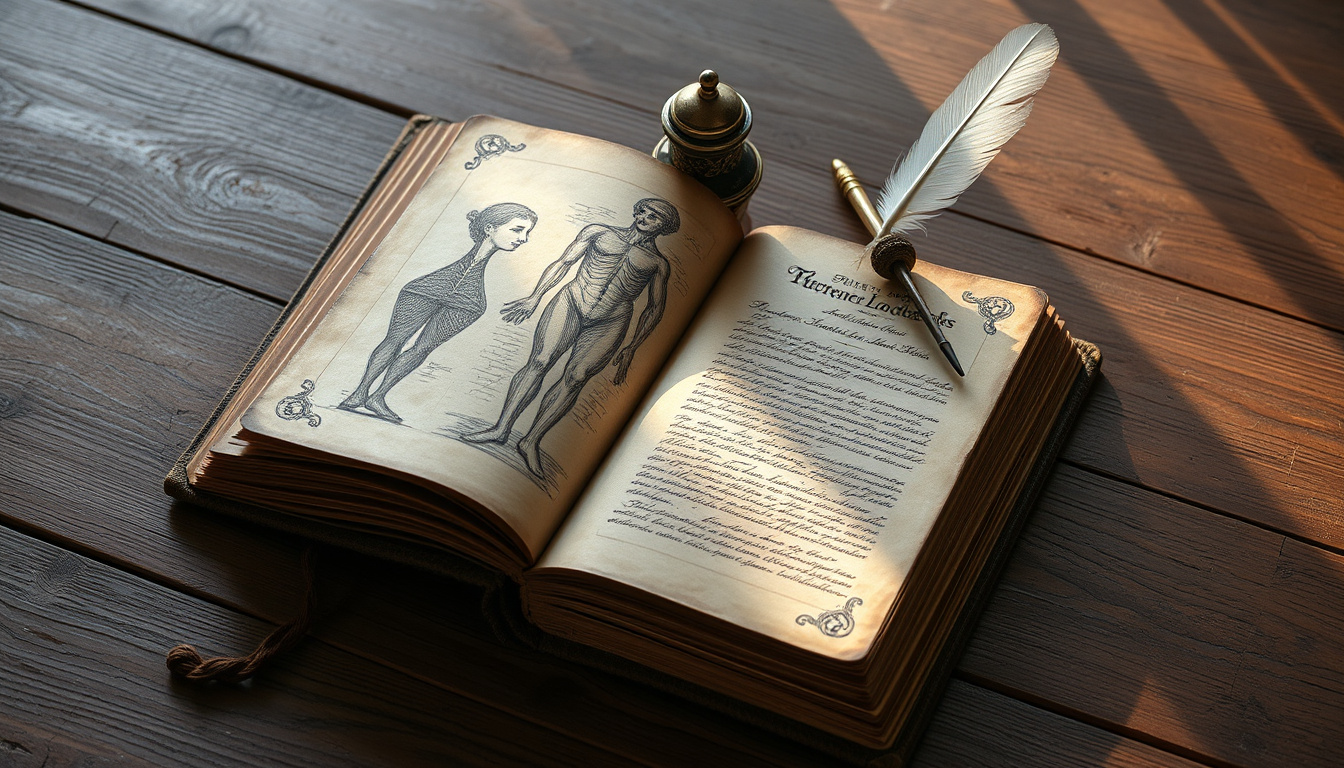
There’s a strange paradox at the heart of Leonardo da Vinci’s fame: the man who painted the world’s most famous picture, the Mona Lisa, finished fewer than 20 paintings in his lifetime. Yet his notebooks overflow with thousands of pages of anatomical studies, engineering designs, and scientific observations that were centuries ahead of their time.
Lived: April 15, 1452 – May 2, 1519 ·
Known as: Italian polymath of the High Renaissance ·
Masterpieces: Mona Lisa, The Last Supper ·
Fields: Painting, engineering, anatomy, invention ·
Surviving notebooks: Over 7,000 pages
Quick snapshot
- Polymath of the Renaissance (National Gallery, London)
- Painted Mona Lisa and The Last Supper (Britannica)
- Died on May 2, 1519 at Amboise, France (Britannica)
- Exact cause of death (possible palsy, stroke, or pneumonia)
- True nature of his relationships with male pupils
- Total number of paintings (estimates vary)
- Born April 15, 1452 in Vinci, Republic of Florence (Museum of Science)
- Apprenticed to Verrocchio in 1466 (National Gallery, London)
- Moved to France in 1516, died 1519 (Britannica)
- Ongoing research into his anatomical drawings and their medical accuracy
- New exhibitions of his notebooks at major museums
- Continued debate over attribution of disputed works
Six key facts about Leonardo da Vinci, one pattern: his life spanned multiple disciplines, yet his output as a painter was surprisingly small.
The table below summarizes the core biographical details that define his legacy.
| Label | Value |
|---|---|
| Full name | Leonardo di ser Piero da Vinci |
| Birth | April 15, 1452, Vinci, Republic of Florence |
| Death | May 2, 1519, Amboise, Kingdom of France |
| Most famous work | Mona Lisa (1503–1519) |
| Number of surviving paintings | Approximately 15–20 |
| Known for | Painting, engineering, anatomy, sculpture, architecture |
What was Leonardo da Vinci most known for?
Leonardo da Vinci is most famous for his paintings Mona Lisa and The Last Supper, but his reputation as a polymath extends far beyond the canvas. He was active as a painter, draughtsman, engineer, scientist, theorist, sculptor, and architect (National Gallery, London). Historians consider him a key figure of the High Renaissance, a period of explosive creativity in Italy (Britannica).
What sets him apart is the sheer breadth of his curiosity. He dissected over 30 human cadavers to understand anatomy, designed flying machines, studied geology and optics, and wrote treatises on painting and mechanics. Yet his completed artworks number fewer than 20, a striking contrast to his prolific notebooks (The Metropolitan Museum of Art).
Leonardo’s fame as a painter rests on fewer than two dozen finished works, while his scientific legacy—largely unpublished in his lifetime—fills over 7,000 notebook pages.
The implication: his cultural impact is built on a tiny fraction of his total output, making him a unique case where reputation far exceeds production.
What caused da Vinci’s death?
The right hand palsy theory
A leading theory suggests Leonardo may have suffered from a right hand palsy, specifically ulnar neuropathy, which impaired his ability to paint in his later years. This idea gained traction from a 2019 study, though the exact cause of his death remains uncertain (Britannica).
Other proposed causes
Some historians propose a stroke or pneumonia as the cause of death. What is known is that Leonardo died on May 2, 1519 at the Château du Clos Lucé in Amboise, France, where he had lived under the patronage of King Francis I since 1516 (Britannica).
No contemporary autopsy report survives, so all theories about his death remain speculative. The palsy theory, while plausible, relies on interpreting his later handwriting and drawings.
Why this matters: understanding Leonardo’s cause of death could shed light on his final years and why he completed so few works after 1510.
Who is more genius, Einstein or da Vinci?
This question is inherently subjective because their genius operated in different domains. Albert Einstein revolutionized physics with his theories of relativity, while Leonardo da Vinci was a polymath whose contributions spanned art, engineering, anatomy, and science. No direct comparison exists; the answer depends on whether you value specialization or multidisciplinary breadth (BBC History).
The pattern: each “genius” label reflects the values of their era. Einstein’s impact was immediate and measurable; Leonardo’s influence took centuries to fully appreciate as his notebooks were studied.
Who was da Vinci’s lover?
Historians widely agree that Leonardo’s relationships included his pupil Francesco Melzi, who was with him until his death, and possibly Gian Giacomo Caprotti, known as Salai, who entered his household around 1490. The exact nature of these attachments remains unclear due to limited records (BBC History).
The trade-off: the lack of explicit documentation means we can only infer from circumstantial evidence, such as the affectionate terms in Leonardo’s notebooks and the fact that both men inherited his artworks and manuscripts.
What are 5 facts about Leonardo da Vinci?
- He was an illegitimate child, born to a notary and a peasant woman (Museum of Science).
- He wrote most personal notes in mirror script, a hallmark of his left-handedness (BBC History).
- He was a vegetarian and bought caged birds to release them (The Metropolitan Museum of Art).
- He left fewer than 20 surviving paintings (Britannica).
- He dissected over 30 human cadavers for anatomical study (BBC History).
Timeline of Leonardo da Vinci’s life
- April 15, 1452 – Born in Vinci, Tuscany (Museum of Science).
- 1466 – Apprenticed to artist Andrea del Verrocchio in Florence (National Gallery, London).
- 1482–1499 – Worked in Milan for Duke Ludovico Sforza (Britannica).
- 1495–1498 – Painted The Last Supper in Milan (Britannica).
- 1503–1506 – Painted the Mona Lisa (Britannica).
- 1516–1519 – Lived in France under King Francis I (Britannica).
- May 2, 1519 – Died at the Château du Clos Lucé, Amboise, France (Britannica).
The pattern: Leonardo’s most productive periods were in Milan and Florence, and his final years in France were marked by declining health.
What we know and what remains unclear
Confirmed facts
- Leonardo was a polymath of the Renaissance (National Gallery, London).
- He painted the Mona Lisa and The Last Supper (Britannica).
- He died on May 2, 1519 (Britannica).
- He was left-handed and often used mirror writing (BBC History).
What’s unclear
- Exact cause of death (possible palsy, stroke, or pneumonia).
- True nature of his relationships with male pupils.
- Total number of paintings (estimates vary).
Quotes on Leonardo da Vinci
“I have offended God and mankind because my work did not reach the quality it should have.”
— Leonardo da Vinci, reported last words according to Giorgio Vasari
Leonardo was a man of “extraordinary physical beauty, infinite grace, and great strength of mind.”
— Giorgio Vasari, Lives of the Most Excellent Painters, Sculptors, and Architects (1550)
These quotes capture the self-critical nature of a genius who felt he never fully realized his ambitions.
Summary
Leonardo da Vinci’s legacy is a study in contrasts: a painter of a handful of masterpieces who produced thousands of pages of scientific inquiry, a man of immense curiosity who left much of his work unpublished. For history enthusiasts and art lovers alike, the lesson is clear: the value of a life’s work is not measured by volume but by the depth of its impact. The next time you stand before the Mona Lisa, remember that its creator gave us far more than that single smile—he gave us a window into the Renaissance mind.
en.wikipedia.org, biography.com, rct.uk, de.wikipedia.org, study.com, youtube.com
For a deeper dive into his surviving masterpieces, see this complete guide to his paintings that catalogs each work’s history and attribution.
Frequently asked questions
How many paintings did Leonardo da Vinci finish?
Approximately 15–20 paintings are attributed to him, with fewer than 20 universally accepted as finished works (Britannica).
Where is the Mona Lisa located?
The Mona Lisa is housed at the Louvre Museum in Paris, France.
Which hand did Leonardo da Vinci use to draw?
He was left-handed and often used mirror writing in his notebooks (BBC History).
Did Leonardo da Vinci design weapons?
Yes, he designed military machines including an armored vehicle, a giant crossbow, and a multi-barreled gun (Britannica).
What did Leonardo da Vinci do that was considered bad?
Some historians note that he accepted commissions from Cesare Borgia, a notoriously ruthless ruler, and he may have participated in the design of weapons of war (Britannica).
How tall was Leonardo da Vinci?
Historical records suggest he was about 5 feet 8 inches (173 cm) tall, based on his skeleton measurements.
Was Leonardo da Vinci a vegetarian?
Yes, contemporary accounts describe him as a vegetarian who bought caged birds to release them (The Metropolitan Museum of Art).
Did Leonardo da Vinci have children?
No evidence suggests he fathered any children; he never married.
Related stories





Jonathan MacDonald is Editor-in-Chief at Civic Maple, overseeing editorial standards, publication decisions and corrections.