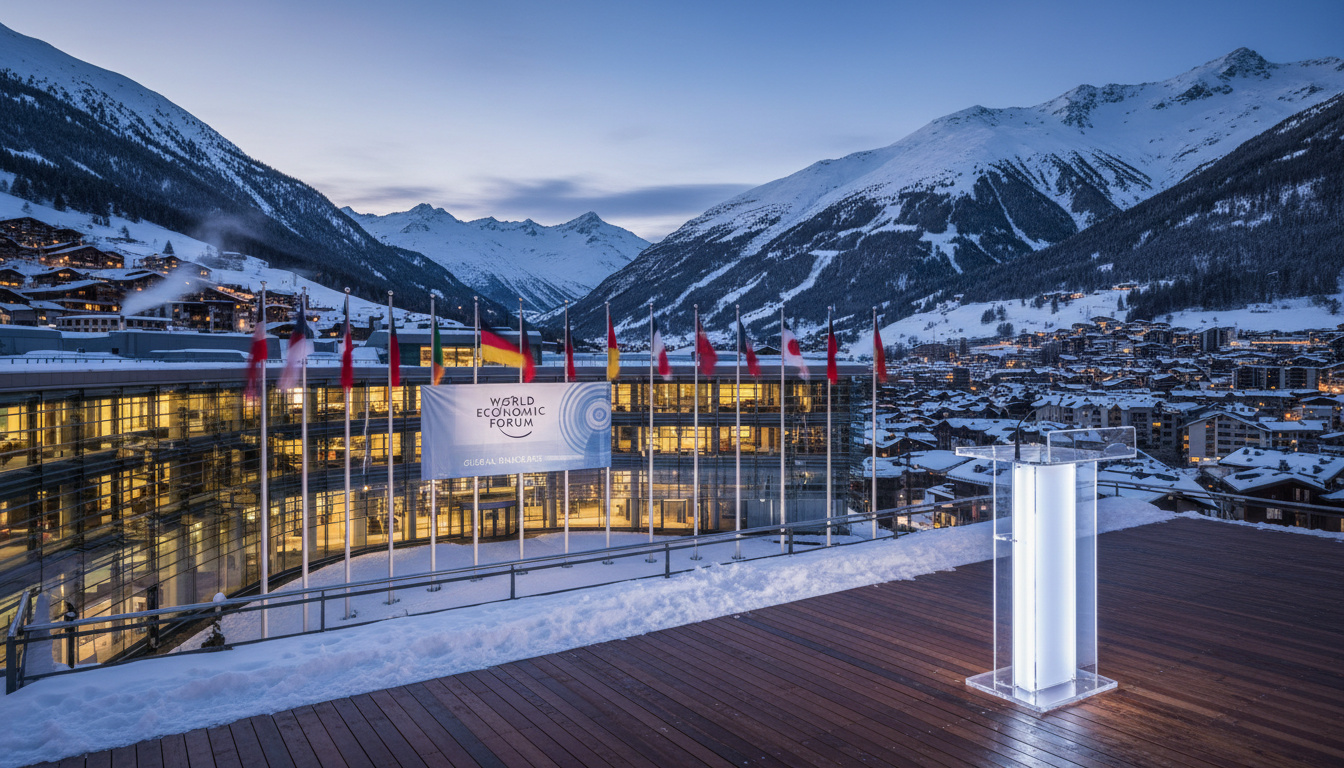
Mark Carney stood before the World Economic Forum in Davos on January 20, 2026, not as a central banker or climate envoy, but as Prime Minister of Canada. His address marked a stark departure from the optimism of previous global gatherings, declaring instead that the “rules-based international order” had become a comforting fiction that no longer matched reality.
The former Bank of England governor framed the current geopolitical moment as a “rupture, not a transition,” urging middle powers to abandon nostalgia and build strategic autonomy. Speaking with the authority of both a seasoned financial crisis manager and a newly elected head of government, Carney outlined a vision where Canada and similar nations must choose between becoming architects of a new order or remaining vulnerable to the whims of great powers.
Contrary to widespread search interest in a “Davos 2024” appearance, verified transcripts and video evidence confirm the speech occurred in January 2026, with no comparable keynote address recorded from the previous year.
What Did Mark Carney Say at Davos?
Mark Carney, Prime Minister of Canada (former Bank of England Governor)
World Economic Forum Annual Meeting 2026
End of rules-based order; strategic autonomy for middle powers
January 20, 2026
- “Friends, it is time for companies and countries to take their signs down” — signaling the definitive end of an era
- The rules-based order was “partially false” even at its supposed height of functionality
- Canada must engage “with open eyes” and accept the world as it is, not as we wish it to be
- Domestic policy shifts include tax cuts on incomes, capital gains, and business investment, plus removal of all federal interprovincial trade barriers
- Defense spending will double by the end of this decade
- Formation of “buyer’s clubs” for critical minerals anchored in the G7 framework
- Bridge-building between the Trans-Pacific Partnership and the European Union to create a 1.5 billion-person trading bloc
| Fact | Details |
|---|---|
| Date of Address | January 20, 2026 |
| Location | Davos, Switzerland (WEF Annual Meeting) |
| Speaker Role | Prime Minister of Canada |
| Central Metaphor | “Taking the sign out of the window” |
| Investment Range | $1 trillion to $8 trillion (sources vary) |
| Defense Commitment | Doubling spending by end of decade |
| Trade Initiative | TPP-EU bridge proposal |
| Key Audience | Global business and political leaders |
| Q&A Topics | U.S. tariff resilience, job creation, G7 growth rates |
| Climate Focus | Absent despite speaker’s UN background |
Key Takeaways from Mark Carney’s Davos Speech
The Rupture in Global Order
Carney characterized the current geopolitical shift as a fundamental break rather than a cyclical adjustment. Great powers now weaponize economic integration through tariffs and supply chain manipulation, rendering traditional multilateral bodies like the WTO and UN increasingly irrelevant. This environment forces middle powers to abandon the assumption that American-led institutions will provide automatic protection.
Canada’s Economic Fortification
The speech outlined concrete domestic measures including tax reductions, the elimination of federal barriers to interprovincial trade, and massive investments in energy, artificial intelligence, and critical minerals. These steps aim to build what Carney termed “strategic autonomy” — the capacity to withstand external economic pressure while maintaining growth.
Carney explicitly characterized the current geopolitical shift as a “rupture, not a transition,” indicating that incremental adjustments to existing institutions will prove insufficient. This framing suggests that the multilateral bodies established in the post-war era now face existential threats requiring entirely new frameworks rather than reform.
The Middle Power Strategy
Rather than mourning the loss of the old order, Carney advocated for “positive offense” — proactive coalition building among like-minded democracies. This includes forming buyer’s clubs for essential resources, bridging trans-Pacific and European trade partnerships, and cooperating on AI governance. The goal is to create a “dense web” of alliances that prioritizes influence over isolation.
When and Where Was Mark Carney’s Davos Speech Delivered?
The 2026 Davos Session
The address occurred on January 20, 2026, during the World Economic Forum’s Annual Meeting in Davos, Switzerland. Full video recordings with timestamped excerpts remain available, allowing verification of specific passages including the “taking signs down” metaphor at approximately 196 seconds and the “engaging the world as it is” segment near the 527-second mark.
Accessing Transcript Records
While no single complete verbatim transcript exists in the public record, substantial excerpts matching closely across multiple sources provide reliable documentation of the speech content. Text versions compiled by transcription services and policy outlets capture the core arguments regarding the end of the rules-based order and Canada’s strategic pivot.
Who Is Mark Carney and Why Davos?
From Threadneedle Street to Parliament Hill
Before assuming Canada’s premiership, Carney served as Governor of the Bank of Canada during the 2008 financial crisis and subsequently as the first non-Briton to lead the Bank of England from 2013 to 2020. This unique dual experience informed his Davos analysis of financial system vulnerabilities and his emphasis on building domestic resilience against external shocks.
Before entering electoral politics, Carney served as Governor of both the Bank of Canada (2008-2013) and the Bank of England (2013-2020), making him the only person to hold both positions. He also served as UN Special Envoy for Climate Action and Finance, though this Davos address notably prioritized geopolitical realignment over environmental finance.
The UN Climate Connection
Despite his previous role as UN Special Envoy for Climate Action and Finance — where he advocated mobilizing private capital for net-zero transitions — the 2026 speech contained no explicit climate finance agenda. Analysis of the full text confirms the focus remained on trade, defense, and strategic autonomy, with energy and minerals discussed primarily through the lens of economic security rather than sustainability.
For those interested in Canadian infrastructure and regional development, Don Valley North Hyundai – Markham Location and Services represents the kind of domestic business operations Carney referenced when discussing interprovincial trade barrier removal.
Timeline of Mark Carney’s Path to the Davos Stage
- : Concludes tenure as Bank of England Governor; begins role as UN Special Envoy for Climate Action and Finance
- : Assumes office as Prime Minister of Canada following electoral transition
- : Delivers special address at World Economic Forum Annual Meeting in Davos
- : Transcripts published by Rev.com and Foreign Policy; video dissemination via YouTube
- : Discussion of U.S. tariff resilience and Canadian job creation data
Separating Fact from Uncertainty in Carney’s Address
Transcription sources vary regarding the scale of Canada’s planned investments, with some recording “$8 trillion” and others “$1 trillion” for energy, AI, critical minerals, and trade corridors. This variance suggests either a verbal misstatement during delivery or transcription error, as official government documents would be required to confirm the precise figure.
| Established Information | Information That Remains Unclear |
|---|---|
| Speech delivered January 20, 2026 | Exact fiscal timeline for doubling defense spending |
| Carney served as PM during address | Specific investment figure ($1T vs $8T variants) |
| Focus on “strategic autonomy” | Specific nations targeted by “buyer’s club” exclusions |
| Removal of federal interprovincial trade barriers | Long-term viability of TPP-EU bridge proposal |
| G7 anchoring for minerals initiative | Whether climate finance will re-enter the policy agenda |
The Geopolitical Context Behind the Speech
The address emerged amid escalating trade tensions and what Carney described as great powers “weaponizing integration.” Unlike his previous Davos appearances advocating for climate finance mechanisms, this speech responded to immediate pressures facing Canada, including tariff threats and supply chain vulnerabilities. The timing reflected a calculation that middle powers could no longer assume the protective umbrella of American-led multilateralism would remain open.
Carney’s framing of “positive offense” — building new structures rather than defending old ones — signaled a generational shift in Canadian foreign policy. By rejecting nostalgia and emphasizing “strength-based” over “values-based” diplomacy, the speech aligned with broader realignments among mid-sized democracies seeking to navigate between competing great powers.
Source Verification and Direct Quotations
Friends, it is time for companies and countries to take their signs down. For decades… countries like Canada prospered under what we called the rules-based international order… The story… was partially false… We’re engaging broadly, strategically, with open eyes. We actively take on the world as it is not wait around for world we wish to be.
— Mark Carney, WEF Davos 2026, via Rev.com transcript
We are taking the sign out of the window. We know the old order is not coming back. Nostalgia is not a strategy. But we believe that from the fracture, we can build something bigger, better, stronger, more just. This is the task of the middle powers.
— Mark Carney, WEF Davos 2026, via Weekly Wilson transcript
The Strategic Implications of Carney’s Davos Message
Mark Carney’s January 2026 Davos address redefined Canada’s global posture for an era of strategic competition, replacing multilateral optimism with pragmatic autonomy. By framing the current disruption as a permanent rupture rather than a temporary crisis, he challenged middle powers to build domestic strength while forging selective alliances—principles that will likely shape Canadian foreign policy regardless of future electoral outcomes. Those monitoring domestic travel and economic connectivity within Canada may find resources like Edmonton to Winnipeg Flights – Deals, Schedules and Booking Tips useful as the nation reconfigures its internal trade corridors.
Frequently Asked Questions
Where can I watch Mark Carney’s Davos speech?
Full video of the January 20, 2026 address is available on YouTube with timestamped excerpts, including sections at 196 seconds on “removing signs” and 527 seconds on engaging with reality.
What topics did Mark Carney cover at Davos?
The speech addressed the end of the rules-based international order, Canadian tax cuts, defense spending doubling, critical minerals buyer’s clubs, AI cooperation with democracies, and plurilateral trade bridges.
Why did Mark Carney speak at Davos in 2026?
As Prime Minister of Canada, Carney addressed the World Economic Forum to outline Canada’s response to geopolitical fractures and to advocate for middle-power strategic autonomy amid great power competition.
Did Mark Carney discuss climate finance at Davos 2026?
No. Despite his background as UN Special Envoy for Climate Action and Finance, the 2026 speech focused exclusively on geopolitical strategy, trade, and defense rather than environmental finance.
What did Mark Carney mean by “taking the signs down”?
The metaphor signaled that companies and countries should stop assuming the old rules-based international order still functions, recognizing instead that great powers now ignore established multilateral rules.
How does Carney’s background relate to his Davos message?
His experience as Governor of both the Bank of Canada and Bank of England informed the economic analysis of systemic vulnerabilities, while his political role demanded the strategic autonomy framework presented.
Related stories




Rebecca Thompson is Managing Editor at Civic Maple, overseeing daily newsroom workflow, commissioning and headline review.