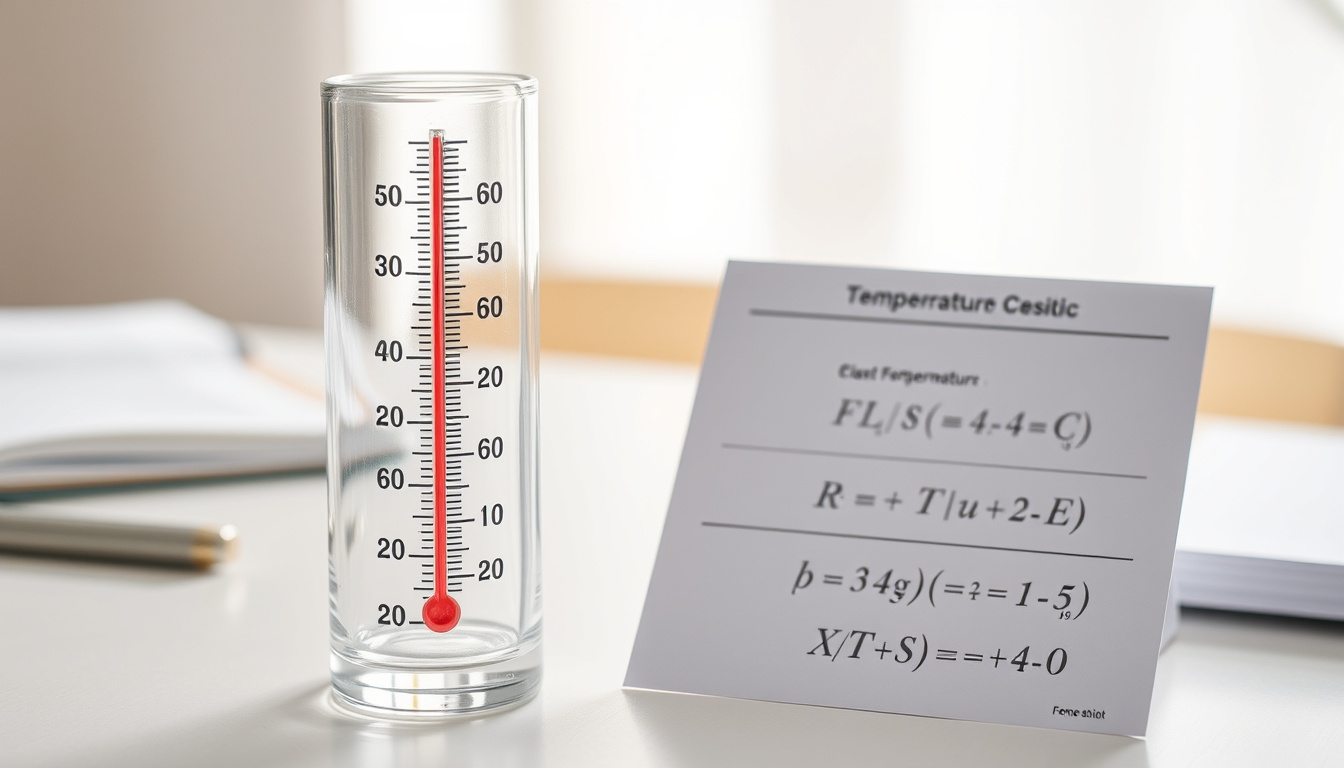
Converting temperatures between Fahrenheit and Celsius is a common task for travelers, scientists, cooks, and anyone working across measurement systems. The conversion relies on a straightforward mathematical formula, though the mechanics often cause confusion. This guide covers the exact method, practical examples, conversion charts, and common pitfalls to help ensure accurate results every time.
The Fahrenheit scale remains the standard in the United States and several other countries, while Celsius dominates most of the world and the scientific community. Understanding how to move between these systems opens access to weather forecasts, recipes, medical readings, and technical documentation regardless of origin. The good news is that once the underlying logic clicks, the conversion becomes second nature.
This article walks through the conversion process step by step, provides a reference chart for common temperatures, explains the reverse conversion, and answers frequently asked questions. Whether recalculating an oven setting, interpreting a fever reading, or planning a trip abroad, the information here serves as a practical reference.
How Do You Convert Fahrenheit to Celsius?
The standard formula for converting Fahrenheit to Celsius is: °C = (°F − 32) × 5/9. This formula accounts for the different zero points and scale intervals of the two systems. The freezing point of water sits at 32°F, which corresponds to 0°C, while the boiling point reaches 212°F or 100°C. The 180-degree spread between these reference points on the Fahrenheit scale maps onto 100 degrees on the Celsius scale, producing the 5/9 ratio embedded in the formula.
The conversion works in two distinct steps. First, subtract 32 from the Fahrenheit value to adjust for the different baseline. Second, multiply the result by 5/9 (or equivalently, divide by 9 and multiply by 5) to account for the differing scale sizes. Skipping or reversing either step introduces error, which is one of the most common mistakes to watch for.
| Temperature Point | Fahrenheit | Celsius | Context |
|---|---|---|---|
| Freezing Point | 32°F | 0°C | Water freezes |
| Boiling Point | 212°F | 100°C | Water boils at sea level |
| Body Temperature | 98.6°F | 37°C | Average human temperature |
| Room Temperature | 68°F | 20°C | Comfortable indoor setting |
| Scale Inventor | Daniel Gabriel Fahrenheit, 1724 | Anders Celsius, 1742 | Historical origins |
To break the process down further, consider converting 70°F, which represents typical room temperature. Subtracting 32 gives 38. Multiplying 38 by 5/9 yields approximately 21.1°C, matching the expected result. The same process applies to any Fahrenheit value, whether the goal is interpreting a weather report or setting a thermostat.
- The formula subtracts 32 first to adjust for the different zero points of each scale.
- The multiplication by 5/9 accounts for the fact that a Fahrenheit degree is smaller than a Celsius degree.
- The factor 5/9 equals approximately 0.556, which is useful when working without a calculator.
- The reverse operation—Celsius to Fahrenheit—uses °F = (°C × 9/5) + 32.
- Rounding conventions vary: one decimal place for precision work, whole numbers for everyday estimates.
- The scales intersect at exactly −40°, meaning −40°F equals −40°C.
- Mental math approximation: subtract 30 from Fahrenheit and divide by 2 for a quick estimate.
Fahrenheit to Celsius Conversion Chart and Examples
Common Temperature Conversions
A conversion chart provides quick reference points without requiring calculation. The following table includes temperatures commonly encountered in daily life, from freezing conditions to high fever readings.
| Fahrenheit (°F) | Celsius (°C) | Common Context |
|---|---|---|
| 0 | −17.8 | Very cold winter day |
| 32 | 0 | Freezing point of water |
| 50 | 10 | Cool autumn day |
| 68 | 20 | Room temperature |
| 77 | 25 | Warm summer day |
| 98.6 | 37 | Normal body temperature |
| 100 | 37.8 | Slightly elevated |
| 212 | 100 | Boiling point of water |
Step-by-Step Conversion Examples
Working through concrete examples reinforces understanding and builds confidence. Each example below follows the formula systematically.
Converting 32°F: Subtracting 32 yields 0. Multiplying by 5/9 keeps the result at 0°C, which aligns with the freezing point of water. This serves as a natural checkpoint because the math is simple and the result is verifiable.
Converting 100°F: The subtraction step gives 68. Multiplying 68 by 5/9 produces 37.8°C, which falls between normal body temperature and the boiling point. This temperature appears frequently in weather forecasts for hot climates.
Converting 98.6°F: This medically significant value subtracts to 66.6. Multiplying by 5/9 yields exactly 37°C, which is why healthcare providers commonly reference this Celsius equivalent when discussing fevers.
When converting temperatures near the freezing or boiling points, compare results against these fixed reference points. If 32°F does not yield 0°C, check whether the 32 was properly subtracted before applying the ratio.
Mental Math Shortcuts
For quick estimates without tools, subtract 30 from the Fahrenheit temperature and divide by 2. Testing this method with 70°F: (70 − 30) ÷ 2 = 20, which is close to the precise result of 21.1°C. The approximation works best within the comfortable temperature range of roughly 50°F to 90°F.
The reverse mental shortcut—Celsius to Fahrenheit—involves doubling the Celsius value and adding 30. For 20°C, doubling yields 40, and adding 30 produces 70°F, which matches the actual value of approximately 68°F. Both shortcuts sacrifice precision for speed, making them useful for everyday situations where exactness matters less than direction.
Celsius to Fahrenheit Conversion (and Vice Versa)
The Reverse Formula
Converting Celsius to Fahrenheit requires reversing the process. The formula is: °F = (°C × 9/5) + 32. Start by multiplying the Celsius value by 9/5, then add 32 to reach the Fahrenheit equivalent. This mirrors the original conversion but in reverse order.
For example, converting 20°C: 20 multiplied by 9/5 equals 36, and adding 32 produces 68°F. This confirms the room temperature reference point used throughout this guide. The symmetry of the formulas means that applying one and then the other returns the original value, with minor rounding differences.
Celsius to Fahrenheit: multiply by 9/5, then add 32. Fahrenheit to Celsius: subtract 32, then multiply by 5/9. The order of operations matters in both cases.
The Point Where Both Scales Match
One of the most interesting properties of these two scales is their intersection at exactly −40 degrees. At this single temperature, the Fahrenheit and Celsius values are identical. Solving the equation where °F = °C produces the result through basic algebra, confirming that −40°F and −40°C represent the same thermal state.
This coincidence has practical utility: in extremely cold regions of Canada and Alaska, weather reports sometimes reference the shared value as a way to simplify communication. It also serves as a useful diagnostic check when testing conversion calculators.
Why Convert Fahrenheit to Celsius?
Global Usage and Scientific Standardization
Most countries worldwide have adopted Celsius as their standard temperature scale. The metric system, which underpins scientific measurement globally, includes Celsius as its unit for temperature. International scientific literature, medical protocols, and engineering standards consistently use Celsius or Kelvin rather than Fahrenheit.
In the United States, however, Fahrenheit remains deeply embedded in everyday life. Weather forecasts, home thermostats, cooking instructions, and medical readings typically appear in Fahrenheit. This creates a persistent need for conversion when communicating across borders or consulting foreign materials.
Practical Reasons for Conversion
Understanding both scales proves valuable across numerous scenarios. Travelers benefit from knowing how to interpret local weather reports and adjust thermostat settings in accommodations abroad. Home cooks following international recipes often encounter oven temperatures in Celsius, making accurate conversion essential for successful results.
Medical professionals increasingly work with international colleagues and literature, where body temperature readings typically appear in Celsius. Converting 98.6°F to 37°C helps bridge communication gaps in healthcare settings where accuracy matters. Similarly, laboratory technicians, HVAC engineers, and industrial workers often need to switch between systems depending on equipment specifications and documentation sources.
Reversing the formula—subtracting 32 after multiplying, or forgetting to subtract 32 entirely—produces incorrect results. Always complete the subtraction before applying the 5/9 ratio when converting Fahrenheit to Celsius.
Scale Differences and Their Implications
The Fahrenheit scale uses smaller degree increments, meaning a change of 1°F represents a smaller temperature shift than 1°C. This finer gradation can provide more nuanced readings in everyday contexts, though the scientific need for such precision is minimal. Weather reporting in Fahrenheit can convey subtle shifts in comfort or conditions that might appear more dramatic when expressed in larger Celsius increments. You can learn how to reset your AirPods by visiting resetear tus AirPods.
The different zero points also affect perception. Water freezes at 32°F, leaving positive temperatures available for most outdoor conditions without dealing with negative values. Celsius, by contrast, dips below freezing more frequently in temperate climates, which aligns more intuitively with the concept of frost and ice.
Understanding the Historical Context
Daniel Gabriel Fahrenheit introduced his temperature scale in 1724, drawing on earlier work by Ole Rømer. Fahrenheit calibrated his original scale using a brine solution for zero, the freezing point of water at 32°F, and human body temperature at approximately 96°F, later adjusted to align more precisely with the freezing and boiling points of water.
Anders Celsius proposed his scale in 1742, originally setting the boiling point of water at 0° and the freezing point at 100°. This inverted arrangement was reversed after his death, standardizing the modern Celsius scale with 0° at freezing and 100° at boiling. This inversion explains why the numbers increase as things get colder in the original proposal but decrease as things get colder in the current version.
- 1724: Daniel Gabriel Fahrenheit publishes his temperature scale.
- 1742: Anders Celsius proposes his temperature scale with inverted reference points.
- Post-1742: The Celsius scale is reversed to match modern conventions.
- 1960s–70s: Most countries adopt Celsius as part of metric system implementation.
- Present: Fahrenheit remains official in the United States, while Celsius dominates globally.
Established Facts and Unresolved Questions
The formula C = (F − 32) × 5/9 produces accurate conversions when applied correctly. The scales intersect at −40°. The boiling point of water at sea level is 212°F or 100°C, while the freezing point is 32°F or 0°C.
- Confirmed: The standard conversion formula is universally accepted and mathematically exact.
- Confirmed: Rounding conventions are context-dependent; one decimal place suits most applications.
- Confirmed: Both scales can be converted bidirectionally without loss of precision when rounding is consistently applied.
- Context-dependent: Whether to round to the nearest whole number or preserve decimals depends on the application.
- Context-dependent: The choice between Fahrenheit and Celsius for reporting may depend on regional norms rather than scientific requirements.
Applications Across Different Fields
In cooking, oven temperatures frequently appear in both scales. A standard moderate oven at 350°F converts to approximately 177°C, which falls between 175°C and 180°C on most thermostat markings. Knowing this range helps home cooks avoid undercooked or burnt results when following foreign recipes. Understanding how to convert f to c for cooking ensures consistent outcomes regardless of the original recipe’s origin.
Weather forecasting uses both systems depending on the country. A temperature of 25°C (77°F) indicates comfortable warm conditions, while 30°C (86°F) signals hot weather. Travelers benefit from internalizing key reference points—0°C as cold, 20°C as mild, 30°C as warm—to quickly gauge conditions without performing calculations.
Medical contexts rely on Celsius for international reporting. A fever of 38°C or higher corresponds to 100.4°F, which is the commonly cited threshold for when medical attention may be warranted. This conversion becomes especially important when reviewing health information from foreign sources or communicating symptoms across language barriers.
Sources and References
The freezing point of water is 32°F, and the boiling point is 212°F. The same two points correspond to 0°C and 100°C on the Celsius scale, respectively, creating the fixed reference points that underpin the conversion formula.
Source: WeatherWizKids
The standard formula for converting Fahrenheit to Celsius is C = (F − 32) × 5/9. This accounts for the different zero points and degree sizes of the two scales.
Source: Cuemath
A frequent mistake is reversing the formula or forgetting to subtract 32 before applying the 5/9 ratio. Both steps are essential to accurate conversion.
Source: US Power Co
Summary
Converting Fahrenheit to Celsius depends on a simple two-step formula: subtract 32, then multiply by 5/9. This process handles any temperature, though common reference points like 32°F (0°C), 68°F (20°C), and 98.6°F (37°C) serve as useful anchors for quick mental checks. The reverse conversion—Celsius to Fahrenheit—inverts the process by multiplying by 9/5 and adding 32. Both scales share a single intersection at −40°, where the values are identical. With these tools, converting between systems becomes straightforward whether for travel, cooking, science, or everyday reference. For related measurement conversions, see our guide on 5 Inch to CM – Exact 12.7 cm NIST Conversion.
Frequently Asked Questions
What is the exact formula for converting Fahrenheit to Celsius?
The formula is °C = (°F − 32) × 5/9. Subtract 32 first, then multiply by 5/9 to obtain the Celsius equivalent.
What is 32°F in Celsius?
32°F equals exactly 0°C, which is the freezing point of water and serves as a fundamental reference point for the conversion.
How do I convert Fahrenheit to Celsius without a calculator?
Subtract 30 from the Fahrenheit value, then divide by 2. For 70°F, this yields approximately 20°C, close to the precise 21.1°C.
What is 100°F to Celsius?
100°F converts to approximately 37.8°C. This falls between normal body temperature and the boiling point of water.
At what temperature are Fahrenheit and Celsius the same?
The two scales intersect at −40°, meaning −40°F equals −40°C. This is the only temperature where both values match.
How do I convert Celsius to Fahrenheit?
Use the formula °F = (°C × 9/5) + 32. Multiply by 9/5 first, then add 32 to obtain the Fahrenheit equivalent.
What is normal body temperature in Celsius?
The standard human body temperature of 98.6°F corresponds to 37°C in medical contexts worldwide.
Why does the conversion formula subtract 32?
The subtraction adjusts for the different zero points. Water freezes at 32°F but 0°C, so the offset of 32 must be removed before scaling the interval.
Related stories





Rebecca Thompson is Managing Editor at Civic Maple, overseeing daily newsroom workflow, commissioning and headline review.