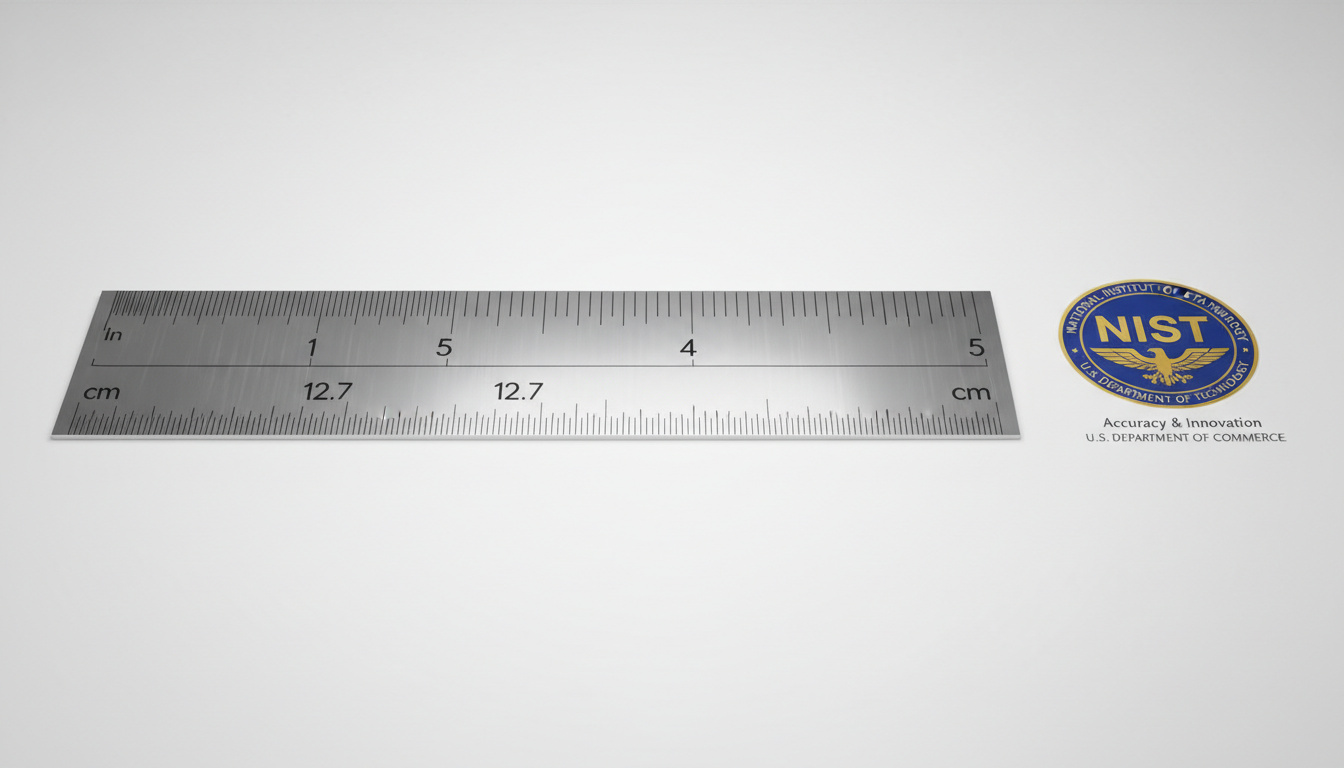
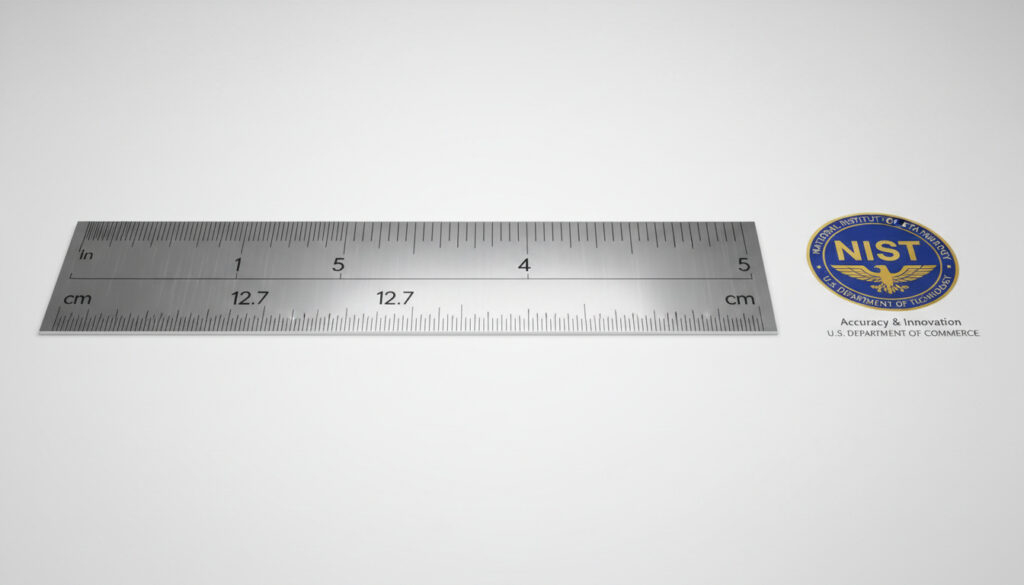
Five inches equals exactly 12.7 centimeters. This conversion follows the international standard defining one inch as precisely 2.54 centimeters, established by the National Institute of Standards and Technology (NIST) and recognized globally.
The relationship between imperial inches and metric centimeters rests on a fixed mathematical ratio. Since 1959, English-speaking nations have unified their length standards, eliminating variations that previously existed between US and imperial measurements.
Understanding this exact conversion proves essential for engineering specifications, international commerce, and everyday tasks like interpreting device dimensions or fabric measurements. The value 12.7 cm represents not an approximation but a definitive mathematical equivalence.
How Many Centimeters Are in 5 Inches?
- Five inches converts precisely to 12.7 centimeters under the international SI system.
- The conversion factor derives from the 1959 agreement defining one inch as exactly 2.54 centimeters.
- This standard applies uniformly across the United States, United Kingdom, Canada, Australia, and other Commonwealth nations.
- In millimeters, 5 inches equals exactly 127 mm, useful for precision engineering.
- Common applications include measuring smartphone screens, tablet dimensions, and compact electronic devices.
- The National Institute of Standards and Technology (NIST) enforces this exact conversion for all US customary units.
- Online calculators apply this exact formula, displaying results to four decimal places (12.7000 cm) when greater precision is requested.
| Inches (in) | Centimeters (cm) |
|---|---|
| 0.5 | 1.27 |
| 1 | 2.54 |
| 2 | 5.08 |
| 3 | 7.62 |
| 4 | 10.16 |
| 5 | 12.7 |
| 6 | 15.24 |
| 8 | 20.32 |
| 10 | 25.4 |
| 12 | 30.48 |
How to Convert Inches to Centimeters
The conversion relies on a single multiplication step. NIST defines the inch as exactly 2.54 centimeters, making calculations straightforward regardless of the specific inch value.
The Standard Formula
To convert inches to centimeters, apply the equation: centimeters = inches × 2.54. Calculator Soup provides an interactive tool that applies this formula automatically.
Step-by-Step Calculation for 5 Inches
Multiply 5 by 2.54. The calculation proceeds as follows: 5 × 2 = 10, 5 × 0.5 = 2.5, and 5 × 0.04 = 0.2. Summing these partial results yields 12.7. Units cancel mathematically: 5 in × (2.54 cm / 1 in) = 12.7 cm.
Write the conversion as 5 in × 2.54 cm/in. The inch units cancel, leaving only centimeters. This dimensional analysis ensures correct unit placement for any conversion factor.
Standardization History and Global Adoption
Before 1959, slight differences existed between the US yard and the imperial yard used in the United Kingdom. These variations created inconsistencies in international trade and engineering.
The 1958 conference of English-speaking nations resolved these differences. Participants included representatives from the United States, United Kingdom, Canada, Australia, New Zealand, and South Africa. NIST documentation confirms that the resulting 1959 agreement defined the inch as exactly 25.4 millimeters, or 2.54 centimeters.
When exploring measurement applications in outdoor recreation, Provincial Parks Near Me – Find, Book and Explore Top Spots often display trail maps using metric standards, reflecting Canada’s adoption of these unified length definitions.
Precision Standards and Modern Usage
Modern definitions leave no room for approximation. The US Federal Register Notice 59-5442, published June 30, 1959, formally announced the exact equivalence. NIST Handbook 44 maintains these standards for current measurements.
The International Bureau of Weights and Measures (BIPM) oversees the SI system, ensuring this inch definition integrates seamlessly with the meter. Worldometers notes that fractional representations like 12 7/10 cm or approximately 12 45/64 cm differ by less than 0.03 millimeters from the exact value.
Just as precise standards matter for engineering, accurate details prove essential for travel planning, similar to when booking Edmonton to Winnipeg Flights – Deals, Schedules and Booking Tips requires exact timing and specifications.
Since 1959, 1 inch equals exactly 2.54 centimeters by international treaty. Consequently, 5 inches contains precisely 12.7 centimeters without rounding or approximation.
Timeline of the Inch Standardization
- : Conference of English-speaking nations convenes to unify length standards.
- : US Federal Register Notice 59-5442 publishes the exact definition of 1 inch = 25.4 mm.
- : United Kingdom, Canada, Australia, New Zealand, and South Africa adopt matching standards.
- : NIST deprecates the legacy US survey foot, reinforcing the international foot at exactly 0.3048 meters.
Exact Conversion vs. Approximation
| Established Information | Uncertainties or Limitations |
|---|---|
| 5 inches = 12.7 cm exactly | Physical rulers may vary by manufacturing tolerance |
| 1 inch = 2.54 cm (NIST/BIPM) | Legacy survey measurements used slightly different standards prior to 2022 |
| Conversion factor is mathematical exact | Fractional approximations (12 45/64 cm) introduce micro-scale variance |
| Applies to all current US customary units | Historical documents pre-1959 may reflect slightly different values |
While 5 inches mathematically equals exactly 12.7 cm, physical measurement tools may introduce tolerance errors of ±0.1 mm or more due to manufacturing limitations.
Inches vs. Centimeters: Measurement Context
The inch belongs to the imperial system, still common in the United States for consumer products, construction, and aviation. The centimeter serves as the standard unit for small lengths in the metric system, used by virtually every other nation globally.
Five inches represents a practical human scale—roughly the width of an adult hand or the height of a large smartphone. In centimeters, 12.7 cm provides the same intuitive reference for those accustomed to metric scales. Demonstration videos show physical rulers aligning these measurements.
Sources and Official Definitions
The value for the inch, derived from the yard, is exactly equivalent to 25.4 mm.
— US Federal Register Notice 59-5442, June 30, 1959
The International Bureau of Weights and Measures maintains the SI system, ensuring the exact relationship between imperial and metric units.
— BIPM Standards Documentation
Summary
Five inches equals exactly 12.7 centimeters according to the international standard defining one inch as precisely 2.54 centimeters. This fixed ratio, established in 1959 and maintained by NIST and BIPM, eliminates calculation uncertainty and applies universally to engineering, commerce, and everyday measurement tasks.
Frequently Asked Questions
How many millimeters is 5 inches?
Five inches equals exactly 127 millimeters, since 1 inch = 25.4 mm and 5 × 25.4 = 127.
Is 5 inches closer to 12 cm or 13 cm?
Five inches equals 12.7 cm, making it closer to 13 cm, though the exact value is 12.7 cm.
What is the conversion factor from inches to centimeters?
Multiply any inch value by exactly 2.54 to obtain centimeters.
Are US inches and UK inches different?
Since 1959, both nations use the same standard where 1 inch = 2.54 cm exactly. Prior to 1959, slight variations existed.
Can I convert fractional inches to centimeters?
Yes. Convert the fraction to decimal inches first, then multiply by 2.54. For example, 5 1/2 inches = 5.5 × 2.54 = 13.97 cm.
Why was 2.54 chosen as the conversion factor?
The 1959 international agreement selected 25.4 mm (2.54 cm) to unify the previously slightly different US and imperial yard standards with metric measurements.
Does 5 inches equal 12.7 cm on all calculators?
Any calculator applying the international standard will show exactly 12.7 cm. Inch Calculator confirms this exact result.
Related stories





Rebecca Thompson is Managing Editor at Civic Maple, overseeing daily newsroom workflow, commissioning and headline review.