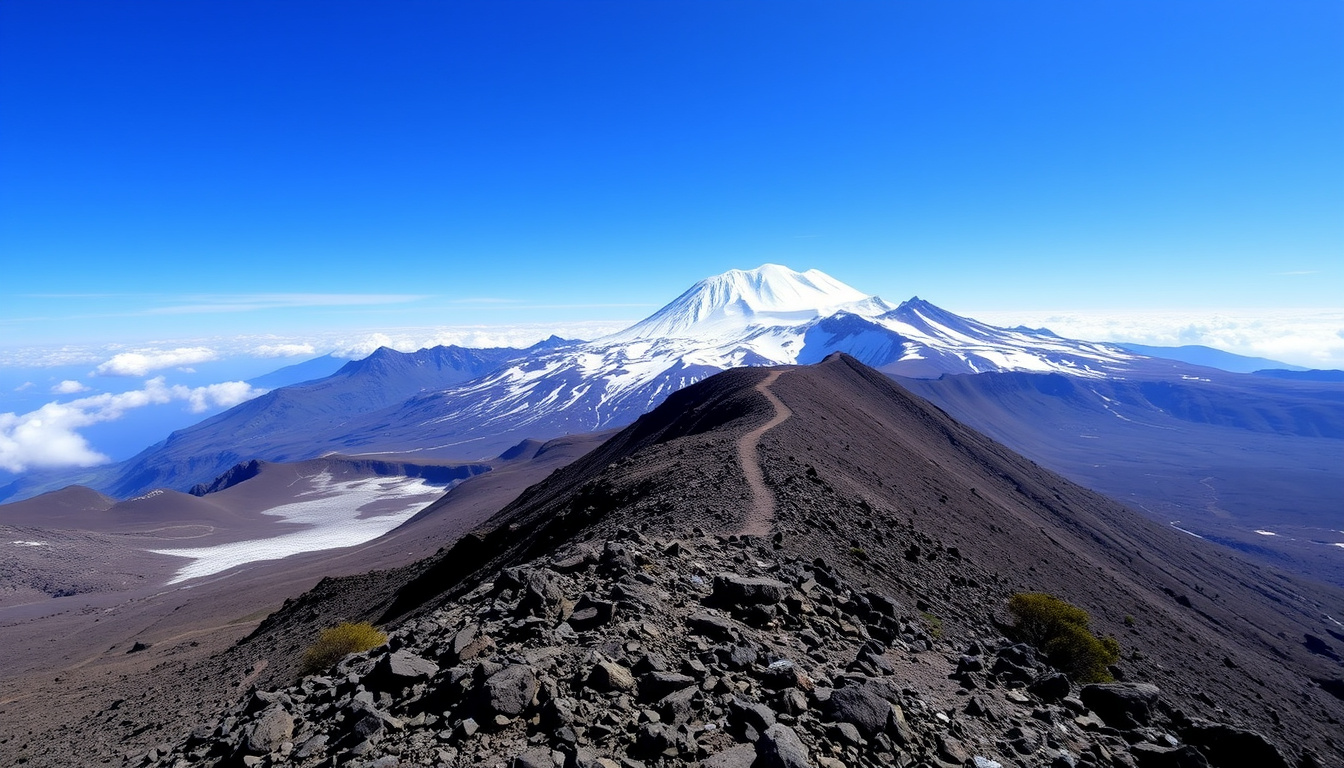
There’s a reason Kilimanjaro shows up on so many bucket lists: it’s the highest mountain in Africa, but it doesn’t require technical climbing skills. That doesn’t mean it’s easy — altitude, weather, and preparation all play a role. Here’s what first-time climbers need to know, from the meaning of Uhuru Peak to how it compares with the world’s other famous giants.
Elevation: 5,895 m (19,341 ft) ·
Summit: Uhuru Peak ·
First Ascent: 1889 ·
Climbing Season: June–October and December–March
Quick snapshot
- Highest point in Africa at 5,895 m
- Located in Tanzania
- Non‑technical climb
- Exact elevation varies 1 m between sources
- Annual death count estimated 10–20
- Overall success rate differs by route
- Exact number of annual climbers varies by source (elevation varies 1 m)
- First ascent in 1889 by Hans Meyer, Ludwig Purtscheller, Yohani Kinyala Lauwo
- Modern summit night typically starts at midnight
- Choose a route: 7 established routes
- Book a qualified guide (mandatory)
- Train for acclimatisation
Six key facts that every climber should have in their back pocket.
| Fact | Details |
|---|---|
| Elevation | 5,895 m (19,341 ft) – highest in Africa |
| Location | Tanzania, East Africa |
| First Ascent | 1889 by Hans Meyer, Ludwig Purtscheller, Yohani Kinyala Lauwo |
| Summit Name | Uhuru Peak (Swahili for “freedom”) |
| Climbing Season | June–October and December–March |
| Number of Routes | 7 established routes |
| Volcanic cones | Kibo, Mawenzi, Shira – Kibo holds Uhuru Peak |
| Shortest climb | 5 days (Marangu Route) |
| Longest climb | 9 days (Northern Route) |
| Summit success (overall) | Varies from 42% (Marangu) to 98% (8‑day Lemosho) |
What is the peak of Kilimanjaro called?
The highest point of Mount Kilimanjaro is Uhuru Peak, a name that means “freedom” in Swahili. Located on the volcanic cone Kibo, it stands as Africa’s tallest summit.
What is the altitude of Uhuru Peak?
- Officially listed at 5,895 m (19,341 ft), though some sources cite 5,896 m – a 1‑metre discrepancy due to measurement differences.
- It is the highest of Kilimanjaro’s three peaks – Kibo, Mawenzi, and Shira.
Why is it called Uhuru Peak?
In 1961, Tanzania gained independence from British rule, and the summit was renamed Uhuru Peak (Swahili for “freedom”) to symbolise the country’s liberation. The name replaced the colonial-era “Kaiser Wilhelm Spitze”.
The implication: the summit’s name connects every climber to Tanzania’s national story – it’s not just a high point, but a political milestone.
Can a beginner climb Kilimanjaro?
Yes – but with conditions. Responsible Travel (travel guide experts) describes Kilimanjaro as a non‑technical hike suitable for people with little or no climbing experience, provided they are physically fit and well prepared. However, success rates vary sharply by route.
How difficult is the Machame or Lemosho route?
- The Machame Route (7 days) is technically non‑technical but steeper than Marangu; Xpats International (climbing logistics site) rates its difficulty as moderate.
- The Lemosho Route is often called the best for beginners – it offers longer acclimatisation and high success rates: 96% for the 7‑day variant and up to 98% for the 8‑day version (per Xpats International).
The longer the route, the better your chance of summit – an extra day on Lemosho can boost your odds from 96% to 98%.
What is the success rate for beginners?
There is no single % for all beginners, but route choice is decisive. The Marangu Route (5–6 days) has a 42% summit success rate – the lowest of all routes – because its shorter duration forces rapid altitude gain. On the other hand, the Lemosho Route (7–8 days) achieves 96–98%.
Do you need supplemental oxygen?
No. Responsible Travel (travel guide experts) emphasises that Kilimanjaro is a “walk‑up” mountain where supplemental oxygen is not required; instead, gradual ascent and proper acclimatisation are the keys to avoiding acute mountain sickness.
The catch: beginner‑friendly does not mean easy – the summit night is a high‑altitude slog that tests mental endurance long after your lungs are gasping.
Which is highest, K2 or Kilimanjaro?
K2 (Wikipedia – mountaineering encyclopedia) stands at 8,611 m (28,251 ft), making it the second‑highest mountain on Earth and significantly taller than Kilimanjaro. However, Kilimanjaro holds a different title: the highest free‑standing mountain in the world – it rises from the plains, not as part of a mountain range.
What is the elevation of K2?
8,611 m (28,251 ft) per Wikipedia (mountaineering encyclopedia) – more than 2,700 m higher than Uhuru Peak.
Why is Kilimanjaro considered the highest free‑standing mountain?
Because it is not part of a mountain range. Kilimanjaro is a giant stratovolcano that rises directly from the surrounding savannah. In contrast, K2 and Everest are both part of the Himalaya–Karakoram system.
What this means: in absolute height, K2 dwarfs Kilimanjaro, but in vertical relief above the surrounding terrain, Kilimanjaro’s 4,877 m from base to summit is among the most dramatic on the planet.
What is harder, Everest or Kilimanjaro?
Everest is in a completely different league. Climbing Everest requires advanced technical skills, supplemental oxygen, and months of preparation. Kilimanjaro, while challenging, is a non‑technical hike that a fit beginner can attempt.
Technical difficulty comparison
- Everest: requires ice‑axe, crampons, fixed ropes, and experience at 8,000 m+; Wikipedia (mountaineering encyclopedia) describes it as a “seriously technical climb.”
- Kilimanjaro: no ropes or technical gear needed; Responsible Travel (travel guide experts) calls it a “walk‑up” with “no technical sections.”
Death rate comparison
- Everest: roughly 1% death rate (climber deaths per summit attempt).
- Kilimanjaro: approximately 0.03% death rate – about 10–20 deaths per year out of ~35,000 climbers.
The trade‑off: Kilimanjaro’s lower fatality rate makes it far safer statistically, but altitude sickness, falls, and hypothermia still claim lives each year. Everest’s danger is more sensationalised, but its sheer scale kills at a much higher rate.
How many climbers died on Kilimanjaro?
The exact number is uncertain. Wikipedia’s list of Kilimanjaro deaths (mountaineering record) records roughly 10–20 fatalities per year, though records are incomplete. The most comprehensive study estimates 1 death per 3,400 climbers.
What are the main causes of deaths on Kilimanjaro?
- Acute mountain sickness (AMS) – the leading cause, often leading to pulmonary or cerebral oedema.
- Falls – especially on the steep scree slopes near the summit.
- Hypothermia – despite the equatorial sun, summit nights drop well below freezing.
- Pre‑existing medical conditions – heart attacks and strokes are common at altitude.
Is Kilimanjaro cursed or evil?
No. The idea that Kilimanjaro is “evil” likely stems from local Chagga mythology that describes the mountain as a dwelling of spirits – not malevolent, but sacred. Responsible Travel (travel guide experts) notes that “evil” claims have no scientific basis; the mountain’s dangers are purely environmental, not supernatural.
Treating Kilimanjaro as “cursed” distracts from the real risks – altitude and weather kill, not spirits. Respect the mountain, not the myth.
The pattern: the real dangers are measurable and manageable, not mystical – preparation replaces superstition.
Comparison: Kilimanjaro, K2, and Everest
Three of the world’s most famous peaks, but they couldn’t be more different. Here’s how they stack up.
| Feature | Kilimanjaro | K2 | Mount Everest |
|---|---|---|---|
| Elevation | 5,895 m | 8,611 m | 8,849 m |
| Technical difficulty | Non‑technical (walk‑up) | Highly technical (5.9, ice, rock) | Technical (ice, rock, high altitude) |
| Death rate | ~0.03% | ~6% | ~1% |
| Oxygen required | No | Yes (above 8,000 m) | Yes (above 8,000 m) |
| Best for beginners | Yes, with proper route and guide | No | No |
The takeaway: Kilimanjaro offers the only realistic path for a beginner among these three giants.
Steps to climb Kilimanjaro
A systematic approach, based on expert guidance from Responsible Travel (travel guide experts) and Xpats International (climbing logistics site).
- Choose your route – Marangu (5–6 days, lowest success), Lemosho (7–8 days, highest success), Machame (7 days, moderate), etc.
- Book a licensed guide – Kilimanjaro National Park mandates that all trekkers be accompanied by a qualified guide (Responsible Travel).
- Train physically – focus on cardiovascular endurance and hiking with a loaded pack.
- Pack essential gear – four‑season sleeping bag, trekking poles, waterproof layers, and altitude‑appropriate clothing.
- Acclimatise properly – take the longer route (Lemosho 8‑day) for gradual ascent; avoid the Marangu 5‑day if possible.
- Follow the “pole pole” mantra – Swahili for “slowly, slowly” – to manage exertion and conserve energy for summit night.
- Summit night strategy – start around midnight; drink plenty of fluids; stick with your guide and group.
Following these steps in order gives a first-time climber the highest probability of success.
Pros and cons of climbing Kilimanjaro as a beginner
Upsides
- Non‑technical – no ropes or climbing experience needed (Responsible Travel)
- High success rates on good routes (96–98% on 8‑day Lemosho, per Xpats International)
- Year‑round climbing seasons (June–Oct, Dec–Mar)
- Stunning landscape variety – rainforest, heath, alpine desert, ice cap
Downsides
- Altitude sickness can hit anyone, regardless of fitness (leading cause of death)
- Low success rate on short routes (42% on Marangu, per Xpats International)
- Cost – guided climbs range $2,000–$6,000
- Summit night is brutally cold and physically draining
The balance: the upsides outweigh the downsides for anyone willing to invest in a longer route and proper preparation.
What is unclear and what is confirmed
Confirmed facts
- Uhuru Peak is the highest point at ~5,895 m (Responsible Travel)
- Kilimanjaro is in Tanzania (Responsible Travel)
- First ascent in 1889 by Meyer, Purtscheller, and Lauwo (Wikipedia)
What’s unclear
- Exact annual death count (10–20 estimated per Wikipedia)
- Overall success rate (varies by route, season, and source)
- Elevation discrepancy (5,895 vs 5,896 m, per Responsible Travel)
- Number of established routes cited differs between sources
The pattern: the core facts are solid, but the margins — exact deaths, exact routes — shift by source.
Quotes from the mountain
“The summit night is the most physically and mentally demanding part of the climb. You start at midnight in the dark and cold, and you have to keep moving – stopping just makes you colder.”
— Guide from Climbing Kilimanjaro (mountaineering resource)
“If you’re a beginner, the Lemosho Route is your best bet. Seven days gives you enough time to acclimatise, and the scenery is incredible.”
— Xpats International (climbing logistics site)
Both accounts — from guide and logistics operator — converge on the same advice: take your time, move steadily, and respect the altitude.
What every climber should take away
Kilimanjaro is not Everest. It is a walk‑up mountain that a determined beginner can conquer with the right preparation. The key is route choice: avoid the 5‑day Marangu if you want a good shot at success; choose the 7–8‑day Lemosho instead. For the beginner looking for a bucket‑list challenge, the trade‑off is clear: invest more days on the mountain, and you dramatically increase your odds of standing on Uhuru Peak at sunrise.
Related reading: Mount Logan: Canada’s Highest Peak Climbing Guide
tourdust.com, followalice.com, ultimatekilimanjaro.com, facebook.com
Frequently asked questions
How much does it cost to climb Kilimanjaro?
Expect to pay between $2,000 and $6,000 for a guided group climb, depending on route, duration, and level of service. Park fees alone are around $600–$800.
What is the best route for beginners?
The Lemosho Route (7–8 days) is widely recommended for its high success rate (96–98%) and gradual ascent schedule (Xpats International).
What gear do I need for Kilimanjaro?
Essentials include a four‑season sleeping bag, trekking poles, waterproof boots, thermal layers, gloves, hat, and a headlamp. A good daypack is also crucial.
Is altitude sickness common on Kilimanjaro?
Yes. Over 50% of climbers experience some form of acute mountain sickness (AMS). The best defence is a slow ascent – choose a route of 7 days or more (Responsible Travel).
How do I prepare for Kilimanjaro?
Start cardio training (running, cycling, stair climbing) 3–4 months in advance. Practice hiking with a loaded pack on steep terrain. Acclimatise mentally for the summit push.
Can you climb Kilimanjaro without a guide?
No. Park regulations require all trekkers to be accompanied by a licensed guide (Responsible Travel).
What is the weather like on the summit?
At Uhuru Peak, temperatures range from -10°C to -20°C (14°F to -4°F) at night, with strong winds. Even during the dry seasons, be prepared for snow and ice.
Related stories





Rebecca Thompson is Managing Editor at Civic Maple, overseeing daily newsroom workflow, commissioning and headline review.