Nothing tests your evening plans like a sudden power outage—and in Quebec, where winter storms can knock out electricity for thousands, knowing how to quickly check the situation and report a problem makes all the difference. Hydro‑Québec’s official Info‑Pannes tool gives you real‑time answers, and here’s exactly how to use it, report an outage, and keep your food safe until the lights come back.
Official outage map visits per day: Over 1.5 million ·
Average power outage duration in Quebec: Under 4 hours ·
Hydro-Quebec customers impacted annually: Approx. 1.2 million ·
Number of Hydro-Quebec customers: 4.4 million
Quick snapshot
- Visit Hydro‑Québec Info-pannes (official outage map) for real-time status.
- Report an outage by calling 1-800-790-2424 (Gouvernement du Québec).
- Exact restoration times depend on weather and damage severity (Hydro‑Québec Info-pannes).
- Food spoilage timing varies with fridge age and how often doors are opened (Gouvernement du Québec).
- A fridge keeps food cold for about 4 hours if unopened (general food‑safety guideline). (Hydro‑Québec Info-pannes)
- Estimated restoration shown on each outage entry on the map (Hydro‑Québec Info-pannes).
- Priority is given to public safety and critical infrastructure. (Hydro‑Québec Info-pannes)
- After reporting, crews are dispatched. Check map for updates. (Gouvernement du Québec)
- For prolonged outages, contact your municipality about warming centres (Gouvernement du Québec).
Three key facts, one pattern: the official sources provide clear instructions but leave some variables (weather, appliance age) to the user’s judgment.
| Item | Details |
|---|---|
| Official outage map | infopannes.solutions.hydroquebec.com |
| Outage reporting phone | 1-800-790-2424 (Gouvernement du Québec) |
| Emergency (life‑threatening) | 911 (Hydro‑Québec safety warning) |
| Fridge without power (unopened) | ~4 hours |
| Full freezer without power | ~48 hours |
| Half‑full freezer without power | ~24 hours |
| Average outage duration | Under 4 hours (Hydro‑Québec) |
| Annual customers impacted | Approx. 1.2 million |
How to Check for a Power Outage in Your Area
Before you call anyone, see if it’s just your house or a wider problem. Hydro‑Québec’s outage map is the fastest way to know.
Using the official Info-Pannes map
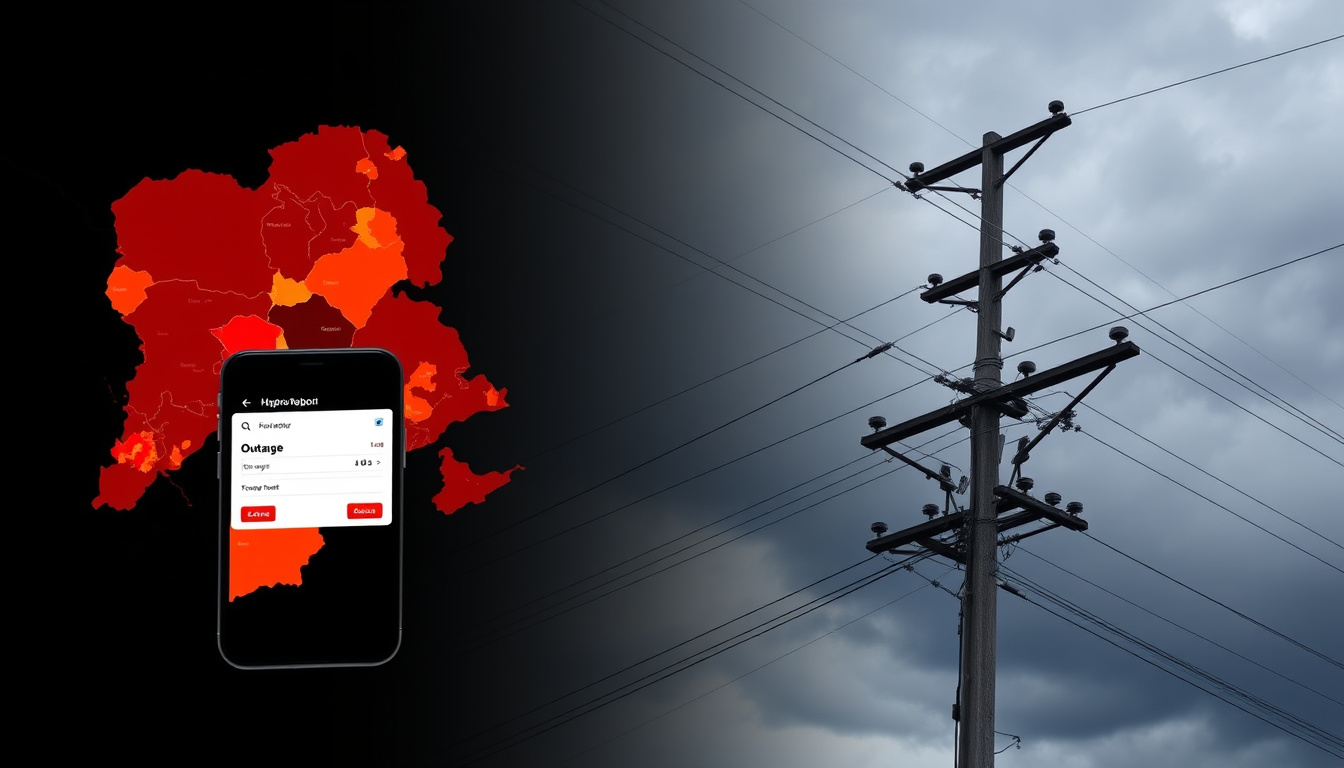
Open Hydro‑Québec Info‑pannes (official power‑outage portal) on any device. The map shows colour‑coded areas: green for normal, yellow for small outages, orange and red for larger ones. Click on an icon or your neighbourhood to see the number of customers affected, the cause (if known), and an estimated restoration time. The data refreshes every few minutes, so you get a near‑real‑time picture.
- Open the official Info-Pannes map on any device.
- Enter your address or street name in the search bar.
- Click on your location to view affected customers, cause, and estimated restoration time.
Why this matters: Relying on the map instead of calling first keeps phone lines open for people who can’t access the internet. It also gives you a clearer picture than asking neighbours who may not have noticed yet.
Real-time outage data by address
On the same map, use the search bar to type your full address or just your street name. The tool will zoom in and highlight your home if it’s affected. You’ll see the current number of customers without power in that area and the estimated time when service should be restored. If no outage is shown for your address but your lights are off, try refreshing the page—it may take a minute for the map to update. If it still says nothing, proceed to report the outage (see next section).
The implication: the map is accurate for widespread events but can lag for isolated single‑home issues, so always follow up with a report if you’re in the dark and the screen looks green.
How to Report a Power Outage to Hydro‑Québec
Once you’ve confirmed there’s an outage affecting you, telling Hydro‑Québec about it helps them track and prioritise repairs. Two options exist: phone or online.
Calling the emergency phone number
Dial 1-800-790-2424. That’s the primary outage reporting line confirmed by the Gouvernement du Québec (emergency‑preparedness guidance). Have your account number handy if you know it, but you can report without one by giving your address. The automated system walks you through a few questions: whether your whole building is without power, only part of it, or if you’re experiencing intermittent flickers. If there’s a danger—like a fallen power line or a fire—call 911 first, as Hydro‑Québec itself warns on its reporting page (Hydro‑Québec safety warning).
Warning: If there is a risk to public safety or someone’s life (downed power line, fire), call 911 before reporting the outage.
What to watch: If you call 1-800-790-2424 and get a busy signal due to high call volume, try the online method mentioned below. The phone number 1-888-385-7252 is sometimes listed on older Hydro‑Québec documents; stick with the 1-800 line for new reports.
Reporting online via the website
Go to Hydro‑Québec’s online reporting flow. The page first asks you to describe the situation: the entire building is without power, part of the building, or intermittent/frequent outages. After that, you’ll confirm that there is no immediate public safety threat (if there is, the site redirects you to 911). Then you provide your address and optionally your account number. Submit the report, and you’ll receive a confirmation number—keep that for your records.
- Go to the online reporting page.
- Select the situation: full building, partial, or intermittent.
- Confirm no public safety threat (otherwise call 911).
- Enter your address and account number (optional), then submit.
The trade-off: online reporting frees up phone lines and gives you a written confirmation, but it requires internet access. If your phone is your only connection, the call route is just as effective.
In short: To report an outage, call 1-800-790-2424 or use the online form. Provide your address and describe the situation. Save the confirmation number.
What to Do During a Power Outage
Once you’ve reported the outage, shift your focus to safety and preserving your food.
Safety measures to take immediately
First, turn off any appliances that were running when the power went out—stove, dishwasher, kettle, washer, dryer—as recommended by the Gouvernement du Québec (outage safety guide). Unplug sensitive electronics (TVs, computers) to protect them from a voltage surge when power returns. Use flashlights or battery‑powered lanterns instead of candles to reduce fire risk.
Tip: Keep your mobile phone charged by using a laptop battery or car charger sparingly.
Check on elderly neighbours or anyone with medical needs. If you rely on electrically powered medical equipment, notify Hydro‑Québec separately and have a backup plan. Keep your mobile phone charged by using a laptop battery or car charger sparingly.
The catch: The same government guidance tells you not to unplug your refrigerator or freezer—leave them plugged in so they restart automatically when power returns. Only the other appliances should be turned off.
Protecting your appliances
As mentioned, leave the fridge and freezer plugged in. Open their doors as little as possible—each opening lets cold air escape and shortens the safe time for your food. A thick towel or blanket over the appliance can add a bit of insulation, but avoid covering vents. After the power restores, check that everything is running normally.
The pattern: small actions (turning off the stove, limiting fridge access) make a measurable difference to both safety and food preservation. They cost nothing but require a moment of thought.
How Long Will the Power Outage Last?
The outage map is your best guess, but several factors influence the real number.
Checking estimated restoration times
Every outage entry on the Hydro‑Québec Info‑pannes map includes an estimated restoration time (ERT) provided by Hydro‑Québec’s control centre. This ERT is updated as crews assess the damage. For small, localised faults the estimate can be as short as 30 minutes; for storm‑related wide outages, it might stretch to several hours or even a day.
During major events (ice storms, windstorms), the map may show a generic message like “Repair in progress” instead of a specific time. In those cases, plan for a longer wait.
Why this matters: Knowing the ERT helps you decide whether to stay home or make alternate arrangements for meals, medication, or pet care.
Factors that influence duration
Hydro‑Québec prioritises public safety and critical infrastructure—hospitals, water pumping stations, nursing homes—before individual residences. Severe weather (ice accumulation, heavy snow, high winds) slows repair work because crews must wait for conditions to be safe. Remote rural areas may experience longer delays than dense urban neighbourhoods because travel distances are greater.
The implication: if you live in a rural area and a winter storm is forecast, prepare for an outage that could last 12 hours or more. The average of under 4 hours is skewed by quick urban fixes.
Food Safety After a Power Outage
When the fridge goes silent, the clock starts ticking on your groceries. Knowing the limits prevents both waste and food poisoning.
How long does food last in a fridge without power?
A closed refrigerator keeps food cold for about 4 hours after the power fails. After that, perishable items like dairy, meat, fish, and leftovers should be thrown out unless you can check the temperature with a thermometer—if any food has been above 4°C (40°F) for more than two hours, discard it. A full freezer keeps its temperature for about 48 hours if unopened; a half‑full freezer lasts half that, roughly 24 hours.
These are standard food‑safety guidelines that align with advice from organisations such as the USDA. Always err on the side of caution: “When in doubt, throw it out.”
Safe food storage guidelines
Write down a quick checklist before the power returns. Items that must be discarded after the 4‑hour fridge window expires: raw or cooked meat, poultry, fish, eggs, milk, soft cheeses, cut fruit, leftovers, and opened sauces. Hard cheeses, butter, whole fruits, and unopened jarred condiments (ketchup, mustard) are generally safe if the fridge hasn’t been opened excessively. For frozen items, check for ice crystals; if the food still feels frozen solid, it can be refrozen or cooked immediately. Never refreeze food that has fully thawed.
The trade-off: tossing borderline food feels wasteful, but a single bout of food poisoning (symptoms: nausea, vomiting, diarrhoea) costs far more in discomfort and medical visits than the few dollars of milk and chicken you might bin.
“If there is a risk to public safety or someone’s life, call 911 before reporting the outage.”
— Hydro‑Québec spokesperson, via the Info‑pannes warning page (Hydro‑Québec)
“Limit how often the refrigerator and freezer doors are opened so foodstuffs are preserved.”
— Gouvernement du Québec, power‑outage safety guide (Quebec government)
Both sources agree on a central insight: most outage damage is not from the blackout itself but from the actions (or inactions) during the first few hours. A quick check of the map, a phone call or online report, and a disciplined fridge policy turn a stressful event into a manageable one.
ecoflow.com, play.google.com, bchydro.com, ca.jackery.com, infopannes.solutions.hydroquebec.com
If you experience a power outage in Quebec, you can check the status using Hydro-Québecs Info-Panne tool, which offers real-time updates.
Frequently asked questions
What is the phone number for Hydro‑Québec power outages?
The number to report an outage is 1-800-790-2424. For life‑threatening emergencies (downed power lines, fire), call 911 first. An alternative number sometimes cited is 1-888-385-7252, but the 1-800 line is the primary official contact.
How do I report a power outage to Hydro‑Québec?
You can call 1-800-790-2424 or report online at Hydro‑Québec’s online reporting system. Both methods ask about the type of outage (full building, partial, intermittent) and require your address. Online reporting gives you a confirmation number.
How long will a power outage last?
Average outage duration in Quebec is under 4 hours, but severe weather can extend that to 12 hours or more. The official outage map shows an estimated restoration time for each incident.
How can I check the Hydro‑Québec power outage map?
Visit infopannes.solutions.hydroquebec.com. Enter your address or city to see current outages, affected customers, and estimated repair times. The map updates every few minutes.
How long can a fridge stay without electricity?
A fridge keeps food cold for about 4 hours if the door stays closed. A full freezer lasts 48 hours; a half‑full freezer lasts about 24 hours.
What should I do with food after a power outage?
Discard perishable items (meat, dairy, eggs, leftovers) if the fridge has been above 4°C (40°F) for more than two hours or if the power was out longer than 4 hours. Frozen food with ice crystals is safe to refreeze or cook. When in doubt, throw it out.
For anyone living in Quebec, the choice is straightforward: bookmark the outage map, save the 1-800-790-2424 number in your phone, and keep your fridge closed. That three‑step habit turns a stressful evening into a routine that lasts only as long as the storm.
Related stories





Rebecca Thompson is Managing Editor at Civic Maple, overseeing daily newsroom workflow, commissioning and headline review.