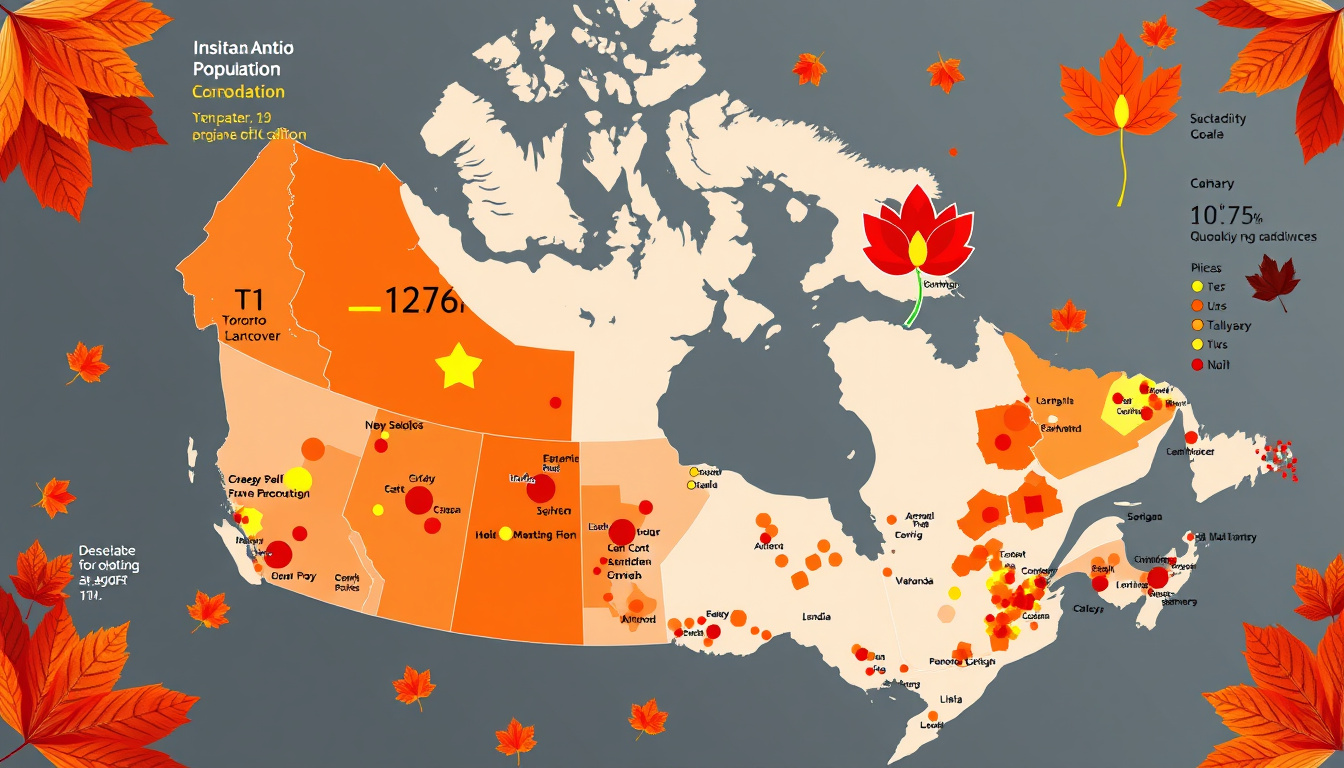
Canada’s Indian-origin population has surged to become the fourth-largest Indian diaspora in the world—larger than the entire population of Ottawa—and the growth traces directly to immigration patterns and family reunification that show no signs of reversing. Fourfold growth since 1996 has reshaped the country’s demographic map, concentrating South Asians heavily in Ontario and British Columbia.
Total Indian origin population: 2,875,954 · Global ranking: 4th largest diaspora · Registered Indians in Ontario: 226,730 (2021)
Quick snapshot
- Over 2.57 million people identified as South Asian in the 2021 Census (Statistics Canada)
- Toronto metro area hosts 812,830 people of Indian origin, the largest concentration in the country (Wikipedia)
- Ontario leads all provinces with 226,730 Registered Indians as of December 31, 2021 (Government of Canada)
- Precise percentage of total Canadian population that Indian Canadians represent
- City-level breakdowns for mid-sized cities beyond the top five metros
- Full capture of temporary residents, students, and recent arrivals post-2021
- Toronto: 408,100 (2001) → 812,830 (2021), doubling in two decades (Wikipedia)
- Vancouver: 155,780 (2001) → 300,195 (2021), nearly doubled (Wikipedia)
- National East Indian total: 713,300 (2001) → 2.57 million (2021) (Statistics Canada)
- One in five recent immigrants to Canada is of Indian origin (18.6%) as of 2021 (India Migration Report)
- South Asians are the fastest-growing national origin group in Canada per the 2021 Census (Wikipedia)
| Metric | Value | Source |
|---|---|---|
| Total South Asian population (2021) | 2,570,000 | Statistics Canada |
| Registered Indians (Dec 31, 2021) | 1,040,319 | Government of Canada |
| Ontario South Asians | 1,484,185 | CIC News |
| British Columbia South Asians | 428,910 | CIC News |
| Toronto metro Indian population (2021) | 812,830 | Wikipedia |
What percentage of Indian population is in Canada?
Total numbers from official sources
The 2021 Census recorded over 2.57 million individuals in Canada identifying as South Asian, an almost fourfold increase since 1996, according to Statistics Canada’s detailed demographic portrait. This makes South Asians the largest non-European ethnic group in the country. When combining census ethnic responses with Registered Indian status data from Indigenous Services Canada, the total population of Indian origin in Canada approaches 2.87 million, as estimated by the World Population Review. The distinction matters: census ethnic data captures the broader South Asian diaspora, while Registered Indian figures refer to First Nations individuals registered under the Indian Act—a separate legal status not tied to South Asian ancestry.
Registered Indians total 1,040,319 as of December 31, 2021, per the Government of Canada—these are First Nations peoples with a distinct legal status. South Asian Canadians numbered 2.57 million in the 2021 Census. The two groups overlap minimally; they refer to fundamentally different populations.
Share of Canada’s total population
With Canada’s total population at approximately 38 million in 2021, the 2.57 million South Asians represent roughly 6.8% of the national population. This places Indian Canadians among the largest visible minority groups in the country. Ontario alone hosts 1.48 million South Asians, making it the provincial hub for the diaspora. The Toronto census metropolitan area (CMA) alone contains 1.1 million South Asians, according to CIC News—more than the entire populations of cities like Calgary or Ottawa.
Which city in Canada has more Indian population?
Top 5 cities ranking
Toronto dominates with 812,830 people of Indian origin in the 2021 Census, representing 13.23% of the metro area’s population. Vancouver follows at 300,195 (11.51% of its metro population), according to Wikipedia’s compilation of census data. Calgary places third with 105,690 Indian residents (7.21%), while Edmonton accounts for 90,660 (6.49%). Montreal, despite being Canada’s second-largest city overall, has a comparatively smaller Indian population of 82,530—only 1.96% of its metro population, reflecting Quebec’s different immigration patterns.
Concentrations in major urban areas
Surrey, British Columbia, stands out for its concentration: nearly 170,000 South Asians make up 32% of the city’s population, per recent estimates. This density surpasses even Toronto’s overall ratio. Winnipeg’s metro area has 50,535 Indian residents (6.16% of population), while Abbotsford, BC, reports 43,855 South Asians despite its smaller total population. Mississauga alone hosted almost 55,000 Indian immigrants in the 2016 Census, according to Moving2Canada. The growth trajectory is stark: Toronto’s Indian population grew from 408,100 in 2001 to 812,830 in 2021, essentially doubling in two decades. Vancouver’s equivalent figures rose from 155,780 to 300,195 over the same period.
“In the 2021 Census, over 2.57 million individuals in Canada reported as South Asian, an almost fourfold increase since 1996.”
— Statistics Canada, Portrait of South Asians in Canada, 2021
From 2001 to 2021, Toronto’s Indian population nearly doubled from 408,100 to 812,830. Vancouver’s Indian population grew from 155,780 to 300,195. These aren’t marginal changes—they reflect sustained immigration and family reunification patterns that show no signs of slowing.
Newcomers choosing where to settle will find the deepest Indian-Canadian community networks in Ontario and British Columbia, where more than a million South Asians already live.
Indian population in Canada by province
The provincial breakdown reveals a stark concentration: Ontario and British Columbia together host nearly two-thirds of Canada’s South Asian population, while every other province accounts for a fraction. The data below draws from recent census analysis and government Registered Indian registries.
| Province | South Asians | Registered Indians (Dec 31, 2021) |
|---|---|---|
| Ontario | 1,484,185 | 226,730 |
| British Columbia | 428,910 | 152,774 |
| Alberta | 267,375 | 134,827 |
| Quebec | 129,000 | N/A |
| Manitoba | 63,235 | N/A |
For policymakers, that Ontario alone holds more South Asians than nine Canadian provinces combined means that provincial immigrant-integration services in that province face disproportionate demand compared with other regions.
Ontario leads with 222,000 registered
Ontario stands as the undisputed center of Indian-Canadian demographic presence. The province hosts 1,484,185 South Asians according to CIC News analysis of recent census data. More specifically, Ontario had 226,730 Registered Indians as of December 31, 2021, according to the Government of Canada’s Indigenous Services data. The Six Nations of the Grand River, located in Ontario, is the largest First Nations band in Canada with 28,019 Registered Indians as of year-end 2021. British Columbia follows as a distant second with 428,910 South Asians, though its density in cities like Surrey makes it distinctive.
British Columbia and other provinces
British Columbia’s 428,910 South Asians are heavily concentrated in the Vancouver metro area (333,385), with Surrey serving as the highest-density South Asian community in Canada at 32% of city population. Alberta rounds out the top three with 267,375 South Asians, concentrated in Calgary and Edmonton. Quebec’s 129,000 South Asians are centered in Montreal, where they represent a smaller share (1.96%) of the more Francophone metro area. Manitoba has 63,235 South Asians, while Saskatchewan and Atlantic provinces have smaller but growing populations. Alberta’s Registered Indians numbered 134,827 (Dec 31, 2021), while British Columbia had 152,774 Registered Indians in the same period.
Who are the top 3 immigrants in Canada?
Largest visible minorities
South Asians are Canada’s fastest-growing national origin group per the 2021 Census. One in five recent immigrants to Canada (18.6%) is of Indian origin, according to the India Migration Report 2024 published by MacEwan University. This makes Indians the largest non-European ethnic group in the country, according to Wikipedia’s demographic analysis. The top three visible minority groups in Canada typically include South Asians, Chinese, and Black populations, with South Asians often ranking first or second depending on measurement methodology.
“Indians are the largest non-European ethnic group in the country and form the fastest growing national origin in Canada.”
— Wikipedia, Indian Canadians article
Indian Canadians ranking
The provincial breakdown confirms this dominance: Ontario alone has 1.48 million South Asians, more than the entire South Asian populations of many other provinces combined. BC’s 428,910 South Asians represent the country’s second-largest provincial concentration. The national picture shows 2.57 million people identifying as South Asian in the 2021 Census, up from 713,300 in the 2001 Census—a 360% increase over two decades. Immigration data reinforces this trend: India consistently ranks among the top source countries for Canadian permanent residents, with the India Migration Report confirming that 18.6% of recent immigrants trace their origins to India.
These figures capture census respondents who self-identified as South Asian or specified Indian origin. Temporary residents—students, temporary workers, asylum seekers—may be undercounted, meaning the actual Indian-born population could be substantially higher than census ethnic data suggests.
Immigration analysts tracking permanent resident admissions will watch India closely as intake targets rise—if current trends hold, India’s share of new arrivals could push past 20% within the next decade.
Where is Mini India in Canada?
Gerrard India Bazaar location
Toronto’s Gerrard India Bazaar, located in the city’s east end, stands as the most recognized concentration of Indian commerce and culture in Canada. The neighborhood features South Asian restaurants, jewelry stores, saree shops, and cultural services concentrated along Gerrard Street East. This area has served as a gathering point for Indian Canadians since the 1970s and 1980s as immigration patterns shifted. It’s often referenced as “Little India” or “Mini India” in Toronto, distinguishing it from other Indian commercial nodes in the city.
Other cultural hubs
Surrey, British Columbia, functions as a parallel hub with its 32% South Asian population and commercial corridors featuring Punjabi-language signage and South Asian businesses. Brampton, Ontario, has similarly developed significant South Asian commercial and community infrastructure. Vancouver’s Punjabi Market on Main Street serves as another cultural nexus. Montreal’s Little India exists but operates on a smaller scale reflecting Quebec’s lower overall South Asian population. These hubs aren’t just commercial centers—they serve as community anchors for cultural events, religious institutions, and intergenerational connection.
Comparison: Indian population across major Canadian cities
Five cities dominate Canada’s Indian population landscape, with Toronto leading by a significant margin over Vancouver.
| City | Indian Population | Share of Metro (%) | Source |
|---|---|---|---|
| Toronto, ON | 812,830 | 13.23% | Wikipedia |
| Vancouver, BC | 300,195 | 11.51% | Wikipedia |
| Calgary, AB | 105,690 | 7.21% | Wikipedia |
| Edmonton, AB | 90,660 | 6.49% | Wikipedia |
| Montreal, QC | 82,530 | 1.96% | Wikipedia |
| Winnipeg, MB | 50,535 | 6.16% | Wikipedia |
The implication: Canada’s Indian population isn’t just large—it’s geographically concentrated in ways that create visible cultural enclaves. Toronto’s 812,830 Indian residents represent 2.7 times Vancouver’s total, but Vancouver’s 11.51% share shows even denser integration relative to its metro population. Montreal’s low 1.96% share reflects Quebec’s distinct immigration patterns and French-language integration pressures.
Related reading: Free CELPIP practice tests for Canadian immigration · SAAQ appointment booking for new residents in Quebec
www12.statcan.gc.ca, statista.com, fnp-ppn.aadnc-aandc.gc.ca, moving2canada.com, toronto.ca
Canada’s 2024 population estimates by province2024 population estimates by province highlight how the 2.88 million-strong Indian diaspora concentrates in Ontario and Toronto.
Frequently asked questions
What is the current Indian population in Canada?
The 2021 Census recorded over 2.57 million people identifying as South Asian in Canada. Combined estimates, including Registered Indians and broader diaspora counts, place the total Indian-origin population at approximately 2.87 million, making it the fourth-largest Indian diaspora globally.
Which province has the most Indians in Canada?
Ontario hosts the largest Indian population in Canada with 1,484,185 South Asians according to recent census data. The province also leads in Registered Indians with 226,730 as of December 31, 2021. British Columbia is second with 428,910 South Asians.
What are the top cities for Indian Canadians?
Toronto leads with 812,830 Indian residents (2021 Census), followed by Vancouver (300,195), Calgary (105,690), Edmonton (90,660), and Montreal (82,530). Surrey, BC stands out for having the highest concentration at 32% of city population.
How many Indians immigrated to Canada recently?
One in five recent immigrants to Canada (18.6%) is of Indian origin as of 2021 data from the India Migration Report 2024. India consistently ranks among the top source countries for Canadian permanent residents, driving continued growth in the diaspora.
Is Indian the largest minority group in Canada?
South Asians are the largest non-European ethnic group in Canada and the fastest-growing national origin group per the 2021 Census. They represent approximately 6.8% of Canada’s total population of 38 million.
Where can I find Mini India in Canada?
Toronto’s Gerrard India Bazaar is the most recognized Indian cultural hub, featuring South Asian commerce and community services along Gerrard Street East. Surrey, BC and Brampton, Ontario also function as major South Asian concentration areas with extensive commercial and cultural infrastructure.
What is the difference between East Indian and Indian Canadians?
“East Indian” is a historical term used in Canadian census data until 1991 to distinguish South Asian Indians from Indigenous peoples in Canada (referred to as “Indians” or “Registered Indians” under the Indian Act). Modern usage prefers “South Asian Canadian” or “Indian Canadian,” while “Registered Indian” specifically refers to First Nations individuals with legal status under the Indian Act—these are not South Asian in origin.
For Indian Canadians choosing where to settle, the data points to Ontario and British Columbia as destinations with the deepest community networks, most established cultural infrastructure, and largest populations of shared background. Toronto leads by volume, but Vancouver offers higher density concentration. Calgary and Edmonton are growing alternatives with lower costs of living. The diaspora has matured from scattered settlement into identifiable urban concentrations that now shape the character of entire neighborhoods and city districts.
Related stories




Rebecca Thompson is Managing Editor at Civic Maple, overseeing daily newsroom workflow, commissioning and headline review.