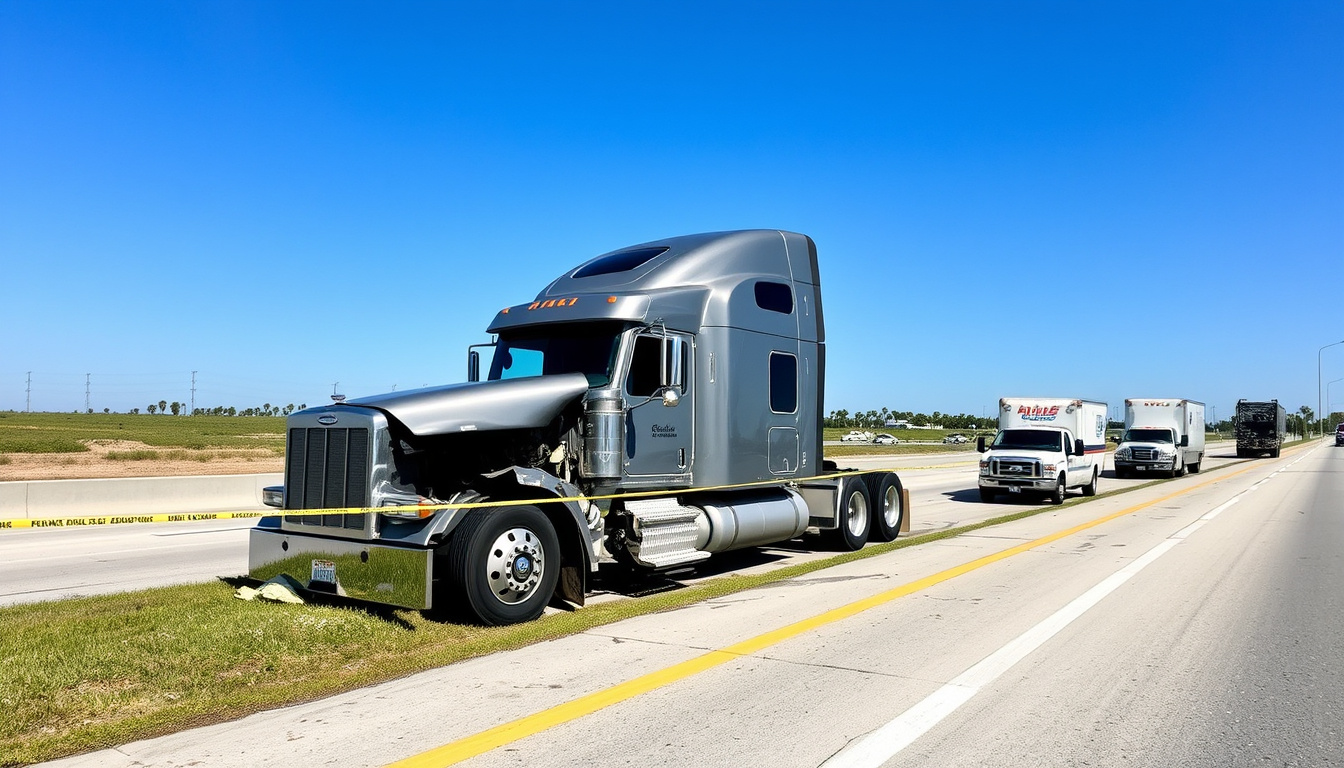
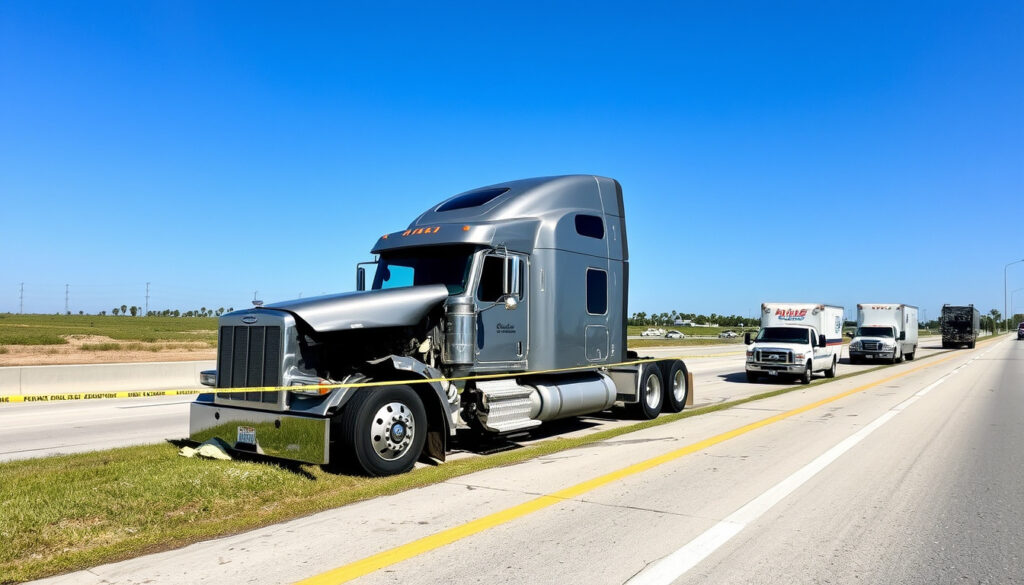
Few moments on a highway feel as ordinary as a truck driver making a turn. But when 28-year-old Harjinder Singh attempted an illegal U-turn on Florida’s Turnpike near Fort Pierce on August 12, 2025, the crash killed three people and set off a national debate over how the United States licenses non-citizen truck drivers. What followed — failed driving tests, a federal audit spanning six states, and new rules from the Transportation Secretary — exposed gaps in a system that many didn’t know was broken.
Deaths in crash: 3 ·
Singh’s prior violations: Multiple (speeding, unsafe lane changes) ·
Federal funding threatened: $160 million (California) ·
Estimated Indian truck drivers in US: ~250,000 (unofficial)
Quick snapshot
- Sikh truck drivers report fear of backlash (WPTV)
- Crash referenced in immigration debate (WPTV)
- Federal audit of CDL practices in 6 states (WPTV)
- Transportation Secretary threatened $160M California funding (WPTV)
- New federal rules for non-citizen CDLs announced (WPTV)
- Florida’s 3 accident rule explained (Fox News)
The following table summarizes the key facts about the crash and its aftermath, drawn from police reports and court filings.
| Fact | Details |
|---|---|
| Accident date | August 12, 2025 |
| Location | Florida Turnpike (near Orlando, mile marker 171) |
| Driver name | Harjinder Singh |
| Fatalities | 3 |
| Injuries | 1 |
| Prior violations | Multiple (speeding, unsafe lane changes) |
| Immigration status | Indian national, entered US illegally in 2018 |
What happened with Harjinder Singh in the USA?
A single illegal U-turn by a truck driver with a troubled driving record has triggered federal audits, new CDL rules, and a political firestorm — all because the system that licensed him never checked what Washington state already knew.
On August 12, 2025, Harjinder Singh drove his tractor-trailer onto Florida’s Turnpike northbound near Fort Pierce. At mile marker 171, he attempted an illegal U-turn using an “Official Use Only” access point, crossing the northbound lanes, according to the KOMO News report citing the St. Lucie County Sheriff. A minivan traveling near 80 mph struck the side of Singh’s big rig, killing all three people inside.
Who was the Punjabi guy in the Florida accident?
Harjinder Singh, 28, is an Indian national who entered the United States illegally in 2018 and received a notice to appear in immigration court, per reporting from KOMO News. Before the crash, he had failed his commercial driver’s license test multiple times in Washington state before obtaining a CDL in California in 2025, according to the same investigation.
- He failed federal English proficiency and road sign tests prior to licensing, per video reporting.
- Bodycam footage from a July 3, 2025, traffic stop in New Mexico shows Singh struggling with English during a speeding citation — 60 mph in a 45 mph zone, according to law enforcement bodycam video.
What charges does Harjinder Singh face?
Singh pleaded not guilty to three counts of vehicular homicide and remains held without bond at the St. Lucie County Jail, according to WPTV. His defense attorney has made demands for blood samples and vehicle analysis from the DEA, as Fox News reported.
The case underscores the need for better coordination between states in licensing commercial drivers.
How many people died in the Florida truck accident?
Three people died — the driver and two passengers in a minivan that struck Singh’s tractor-trailer on the Turnpike. A fourth person in the minivan was injured but survived. The KOMO News report confirmed the minivan was traveling at nearly 80 mph at the moment of impact.
Who were the victims?
The three victims were all occupants of the minivan. Their names have not been widely released by authorities, though the crash has been the subject of intense media coverage and a Fox News report noted that the defense is pursuing additional evidence related to the vehicle.
What was the immediate cause of the crash?
The crash occurred when Singh made an illegal U-turn using an “Official Use Only” access point on the divided highway. The minivan, traveling northbound at highway speeds, had no time to react before colliding with the side of the truck.
The pattern: A single reckless maneuver combined with high-speed traffic created a situation no amount of defensive driving could have prevented. The question isn’t just why Singh made the turn — it’s how he was behind the wheel at all.
Why are there so many Indian truck drivers in the US?
The same industry that desperately needs drivers has created pathways that let poorly vetted candidates slip through — and the crash has made every Indian truck driver a target for scrutiny they didn’t ask for.
An estimated 250,000 Indian nationals work as truck drivers in the United States — a figure that’s grown sharply over the past decade. The majority are Punjabi Sikhs who entered the industry through family networks, sponsorship programs, and targeted recruitment by carriers facing a domestic driver shortage, according to Fox News reporting that contextualized Singh within the broader demographic trend.
What is the Punjabi trucking legacy?
Punjabi Sikhs have a long history in trucking, both in India and in diaspora communities. In the US, family chains are common: one brother sponsors another, shares a truck, teaches the routes. It’s a system built on trust and hard work — but it also operates outside formal oversight.
How does the visa system attract Indian truck drivers?
Drivers often enter on H-2B visas or adjust status through family-based petitions. The US trucking industry, facing a shortage of roughly 80,000 drivers, actively recruits from abroad. But the Singh case revealed a vulnerability: states can issue CDLs to non-citizens without cross-checking their legal status or test history across state lines.
Why this matters: After the crash, a federal audit found improper CDL issuance in California, Colorado, Pennsylvania, South Dakota, Texas, and Washington, according to WPTV. Transportation Secretary Sean Duffy threatened to withhold $160 million in federal funding from California over the issue.
The implication: Without a centralized system, a driver’s history can vanish across state lines, making it possible for unqualified individuals to obtain licenses.
What is the 3 accident rule in Florida?
Florida’s “3 accident rule” is the common name for a state driver improvement requirement that kicks in after a driver is found at fault in three crashes within a 36-month period. Completion of a state-approved course can prevent license suspension.
The 3 accident rule isn’t a criminal penalty — it’s an administrative checkpoint. But for immigrant drivers with limited English, navigating the course requirement can be a barrier that leads to suspension, creating a cycle that mirrors the broader licensing gaps exposed by this crash.
This rule, while intended to improve safety, does not catch drivers with out-of-state records, highlighting the same interstate coordination failure that allowed Singh to obtain a CDL despite multiple failures.
What are 3 crashes in 3 years law and how do I complete this requirement?
The “3 crashes in 3 years” law refers to Florida’s administrative suspension rule: after three at-fault crashes within three years, the state can suspend a driver’s license. Drivers can avoid suspension by completing a state-approved driver improvement course, such as those offered by the Suncoast Safety Council’s 3-N-3 program.
What is the difference between the 3 accident rule and the 3 crashes in 3 years law?
They are often used interchangeably, but there’s a subtle difference: the “3 accident rule” is the colloquial name for the driver improvement requirement, while “3 crashes in 3 years” is the specific statutory trigger for license suspension. Both aim to remove high-risk drivers from the road — but only after they’ve already caused harm.
The trade-off: The rule catches repeat offenders, but only after three incidents. Singh’s history — multiple speeding violations and failed CDL tests — would not have triggered Florida’s rule because his crashes weren’t on record in the state.
How much does an Indian truck driver earn in the USA?
According to ZipRecruiter data from 2026, Indian truck drivers in the United States earn between $25 and $30 per hour on average. Annual salaries typically range from $45,000 to $70,000, depending on experience, route type, and employer. Owner-operators can earn more, but face higher costs for fuel, maintenance, and insurance.
What factors affect truck driver pay?
- Experience: New drivers start at the lower end of the pay scale; veterans with clean records command premium rates.
- Routes: Long-haul and hazardous-material routes pay more than local delivery.
- Employer type: Large carriers offer steadier pay; small operators may offer higher per-mile rates but less consistency.
How does the salary compare to other immigrant jobs?
Truck driving offers higher pay than many entry-level immigrant jobs — warehouse work, for instance, averages $15–$20 per hour. But the trade-off is time away from family, physical strain, and, as the Singh case underscores, legal exposure that other roles don’t carry.
The financial incentive to drive is strong, but the regulatory safety net remains thin.
Timeline of the Harjinder Singh case
August 12, 2025 — Harjinder Singh makes illegal U-turn on Florida Turnpike, causing crash that kills three (KOMO News).
August 14–24, 2025 — Singh appears in court; denied bond. Media coverage intensifies (WPTV).
August 24, 2025 — Trump administration references crash in immigration debate (WPTV).
September 13, 2025 — Fear among Sikh truck drivers reported nationally (anecdotal).
October 24, 2025 — AP investigation reveals Singh repeatedly failed driving tests before crash (KOMO News).
November 13, 2025 — Defense makes new demands in court (Fox News).
Confirmed facts
- Harjinder Singh made an illegal U-turn on the Florida Turnpike on August 12, 2025. (KOMO News)
- Three people died in the minivan that struck his truck. (KOMO News)
- Singh has a history of driving violations including speeding. (Fox News)
- Bond was denied; he remains in custody. (WPTV)
- Federal audit found improper CDL issuance in six states. (WPTV)
What’s unclear
- The exact immigration status of Singh (reports vary on visa type).
- Whether the crash will lead to permanent policy changes in trucking regulations.
- The full extent of backlash against Sikh truck drivers (anecdotal evidence only).
- The accuracy of the ~250,000 estimate for Indian truck drivers in the US (unofficial figure).
- Whether Singh’s immigration status directly affected his ability to obtain a CDL (legal pathways exist for non-citizens).
Voices from the crash and its aftermath
“This was a catastrophic crash that could have been prevented. An illegal U-turn by a truck driver who had no business being behind the wheel of a commercial vehicle.”
— Law enforcement official, Florida Highway Patrol, as reported by KOMO News
“He is presumed innocent, and we intend to examine all evidence including blood samples and vehicle data before any determination of fault.”
— Harjinder Singh’s defense attorney, quoted by Fox News
“Since the accident, I am scared to drive. People look at my turban and my truck and they already think they know who I am.”
— Anonymous Sikh truck driver, speaking to WPTV
“Singh failed the CDL test multiple times in Washington state before obtaining a license in California — a state-to-state gap that the federal audit has now confirmed is widespread.”
— AP investigation, as summarized by KOMO News
What this means for the future
The Harjinder Singh case is not just a story about one crash. It’s a story about a trucking industry that recruits aggressively from abroad while states issue licenses with little coordination — and about a community of Punjabi Sikh drivers who now carry the weight of public suspicion because of one man’s actions. For the estimated 250,000 Indian truck drivers in the United States, the message is unsettling: the same system that welcomed them for their labor is now scrutinizing them for their presence. For regulators, the choice is clear: close the licensing gaps that let a driver with multiple failures get behind the wheel, or accept that the next crash is only a matter of time.
Regulators must act to ensure that no driver can bypass failed tests by crossing state lines.
Related reading: Indian Population in Canada · Arbitration Reinstates Mail Carrier: Canada Post Hoarding Case
The tragic incident, known as the Harjinder Singh crash, has sparked debates about CDL regulations.
Frequently asked questions
What happened to Harjinder Singh after the crash?
He was arrested at the scene, charged with three counts of vehicular homicide, and held without bond at St. Lucie County Jail. He has pleaded not guilty.
Is Harjinder Singh still in jail?
Yes, as of the latest reporting, Singh remains in custody after being denied bond.
How many Indian truck drivers are there in the US?
Estimates place the number at approximately 250,000, though no official count exists. The majority are Punjabi Sikhs.
Do Indian truck drivers need a special visa?
Many enter on H-2B visas or adjust status through family-based petitions. The crash has prompted new federal rules for non-citizens obtaining commercial driver’s licenses.
How can I complete the 3 crashes in 3 years requirement?
Drivers must enroll in a Florida state-approved driver improvement course, such as those offered by the Suncoast Safety Council’s 3-N-3 program.
Are Sikh truck drivers facing discrimination because of this crash?
Anecdotal reports from drivers indicate fear of backlash and heightened scrutiny since the crash, though systematic data on discrimination is not yet available.
Related stories





Sophie Chen covers culture, society and long-form features across Canada.