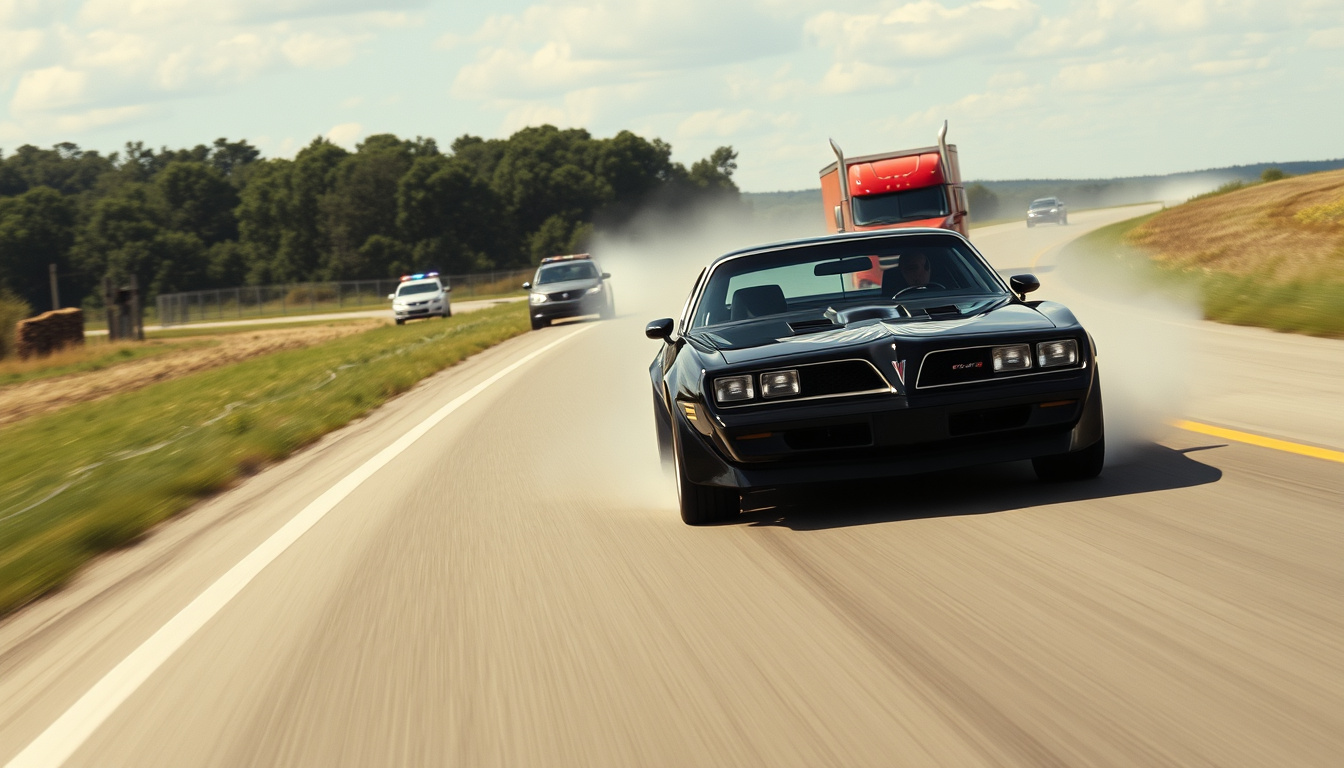

Burt Reynolds made driving look like the only career worth having in Smokey and the Bandit, and a 1977 Pontiac Trans Am became shorthand for freedom on four wheels. This guide breaks down the famous lines, the illegal plot that started it all, the full franchise lineup, and whether the films still hold up.
Release Year: 1977 · Director: Hal Needham · Starring: Burt Reynolds, Sally Field, Jackie Gleason · Runtime: 96 minutes · Genre: Action Comedy Road Film
Quick snapshot
- Exact production budget of original 1977 film
- Seth MacFarlane/Danny McBride reboot timeline and current status
- Full cast details across all three films
- Original film: May 27, 1977 (Wikipedia)
- Sequel: August 15, 1980 (Wikipedia)
- Part 3: August 12, 1983 (Wikipedia)
- TV movie: 1994 (LibraryThing)
- Seth MacFarlane and Danny McBride developing new TV iteration (TV Insider)
- No release window announced yet (TV Insider)
Key production and plot details for the original film are summarized in the table below.
| Detail | Value |
|---|---|
| Release Date | May 27, 1977 |
| Director | Hal Needham |
| Box Office | $126.7 million (franchise total) |
| Main Car | 1977 Pontiac Trans Am |
| Total Theatrical Films | Three |
| Route in Original | Texarkana to Atlanta |
| Cargo | 400 cases of Coors beer |
| Lead Actor | Burt Reynolds |
What is the famous line from Smokey and the Bandit?
The most recognizable line isn’t actually a catchphrase in the traditional sense. The opening narration sets the tone: “For The Good Old American Life. For The Money, The Glory, And The Fun. Mostly For The Money.” (Screen Rant)
Key quotes from the film
- “10-4” — the CB radio acknowledgment that becomes the film’s shorthand for trucker communication
- The Bandit’s declaration that he’s “for the money, the glory, and the fun” — capturing the antihero’s unapologetic drive
- Sheriff Justice’s outraged sputtering whenever the Bandit outmaneuvers him — more comedy than threat
The film’s quotable power comes from attitude over cleverness. It’s not witty wordplay — it’s the confidence with which the Bandit delivers his worldview. That swagger is what audiences remember decades later.
Context in the film
The opening narration frames the entire film as a cash-driven adventure. The Bandit isn’t a noble figure or a reformed criminal — he wants money, and he figures out a way to get it while having the time of his life. This sets up the core appeal: watching someone refuse to take anything seriously while being exceptionally good at everything he does. (Screen Rant)
What was illegal about Smokey and the Bandit?
The entire premise of the original film centers on smuggling. Two bootleggers — Bandit and his partner Cledus “Snowman” Snow — take on a job to illegally transport 400 cases of Coors beer from Texarkana to Atlanta in under 28 hours. (Wikipedia)
Beer run from Texas
In the 1970s, transporting Coors beer across state lines was actually illegal in some contexts due to regional distribution agreements. The film takes this legal gray area and turns it into a high-stakes race. Snowman drives the truck loaded with the beer while the Bandit drives a 1977 Pontiac Trans Am to distract law enforcement — creating a moving decoy system that keeps the cargo moving. (Wikipedia)
Sheriff chase details
Sheriff Buford T. Justice pursues the Bandit across multiple states, turning what should be a straightforward delivery into a cross-country chase. The sheriff’s obsession with catching the Bandit provides the comedy — he’s competent enough to be a threat but bumbling enough to consistently fail. (Screen Rant)
The illegal premise isn’t just flavor text — it’s the engine driving every chase scene, every close call, and every moment of the Bandit’s swagger. Strip away the beer run and you lose the film’s entire structure.
What are the Smokey and the Bandit movies?
The franchise spans three theatrical films released over six years, plus a 1994 television movie. Each entry shifts the central mission while keeping the core cast. (Wikipedia)
Original 1977 film
The original centers on the 28-hour beer run from Texarkana to Atlanta. Burt Reynolds as the Bandit and Jerry Reed as Snowman make an unlikely pair — one’s a reckless driver, the other’s a straight-laced trucker — but their chemistry carries the film. Jackie Gleason’s Sheriff Justice provides the antagonist, and the 1977 Pontiac Trans Am becomes as much a character as any of the humans.
Sequels including 2 and 3
Smokey and the Bandit II (1980) returns with the same core cast but swaps the beer for an elephant. The Bandit and Snowman must deliver an animal to the GOP National Convention in three days. The film became the eighth-highest-grossing domestic film of 1980 in the United States. (Wikipedia) It was even released under an alternate title in some Commonwealth countries. (Wikiquote)
Smokey and the Bandit Part 3 (1983) took a different approach. Jackie Gleason reportedly played both Sheriff Justice and the Bandit in early cuts, but test audiences reportedly disliked seeing Gleason as the Bandit, leading to re-shoots with Jerry Reed brought back in the role. (The Action Elite)
The implication: Part 3’s production turmoil shows how audiences expected Burt Reynolds in the lead, and the studio had to scramble when that wasn’t possible initially.
Is Smokey and the Bandit a good film?
By modern critical standards, the original holds up best as a cultural artifact than as pure filmmaking. The action sequences are impressive for their era, the comedy lands more often than it misses, and Reynolds’ charm remains undeniable. (Screen Rant)
Critical reception
The original film performed well commercially but received mixed critical reviews upon release. Modern retrospective views tend to be warmer, recognizing the film as a product of its era that captured a specific American fantasy about freedom and rebellion. (Wikipedia)
Audience views
The audience score reflects genuine affection — viewers return to these films for the same reasons they first showed up: Reynolds’ magnetism, the car chases, and a script that prioritizes fun over depth. The films never pretended to be anything more than entertainment, and that honesty has helped them age better than many contemporaries that aimed higher.
Who is Smokey in Smokey and the Bandit?
There’s no character actually named “Smokey” in the franchise — the title refers to the CB radio term for police officers, not a specific person. But the inspiration behind the name is Sheriff Buford T. Justice, played by Jackie Gleason. (Wikipedia)
Sheriff role
Justice is a Texas county sheriff who becomes obsessed with catching the Bandit after the bootlegger’s truck passes through his jurisdiction. His single-minded pursuit across multiple films makes him both the antagonist and, arguably, the second most important character in the franchise.
Jackie Gleason portrayal
Gleason transforms what could have been a one-note villain into a comedic icon. His delivery — part bluster, part outrage, part genuine incompetence — makes Sheriff Justice simultaneously threatening and hilarious. The character’s stupidity is portrayed as lovably funny rather than purely annoying. (Screen Rant)
Upsides
- Burt Reynolds’ iconic screen presence and chemistry with Jerry Reed
- Memorable car chase sequences that influenced action films for decades
- Jackie Gleason’s comedic performance as Sheriff Justice elevates the antagonist role
- 1977 Pontiac Trans Am became a cultural symbol of the era
- Simple, effective premise executed with confidence
- The Bandit character is a relatable antihero driven by money and fun, not redemption arcs
Downsides
- Plot is thin by modern standards — the premise doesn’t support deep storytelling
- Some jokes and character beats feel dated, particularly around gender dynamics
- The sequels, especially Part 3, failed to capture the original’s magic
- Limited character development beyond the central trio
- Some viewers find the CB radio banter overused
- The “Smokey” name refers to law enforcement in general, not a specific character — can be confusing
Key quotes
“For The Good Old American Life. For The Money, The Glory, And The Fun. Mostly For The Money.”
— Opening narration, Smokey and the Bandit (1977) via Screen Rant
“I said it was a Pontiac, not a Toyota. […] That’s a Trans Am, baby.”
— Bandit, demonstrating the film’s attitude toward American machinery via Wikipedia
“He was just a little too mean to be a hero. He was a lot of fun to watch.”
— Critical assessment of the Bandit character via Screen Rant
Related reading: Pirates of the Caribbean 1 – Plot, Cast, Box Office Guide
Burt Reynolds as the Bandit and Jackie Gleason’s memorable sheriff shine brightest, as explored in this Swedish cast breakdown of the action-comedy classic.
Frequently asked questions
What car is used in Smokey and the Bandit?
The Bandit drives a 1977 Pontiac Trans Am throughout the original film. This car became so iconic that it remains one of the most recognizable vehicles in American film history. (Wikipedia)
What is the song from Smokey and the Bandit?
The film features several country and Southern rock tracks that were popular at the time. The soundtrack contributed to the film’s era-specific atmosphere, though no single song became as iconic as the film’s imagery.
Did Burt Reynolds like Smokey and the Bandit?
Reynolds reportedly embraced the Bandit role as the defining performance of his career. The character’s confidence and swagger aligned closely with Reynolds’ own public persona, and he leaned into that connection throughout his career.
What is Smokey and the Bandit 2 about?
Smokey and the Bandit II (1980) follows the Bandit and Snowman as they transport an elephant to the GOP National Convention in three days or less. It brought back the original cast and became the eighth-highest-grossing domestic film of 1980 in the United States. (Wikipedia)
Where can I watch Smokey and the Bandit trailer?
The original trailer and related footage are available on the film’s official streaming pages and various video platforms. Check major streaming services for current availability.
What did Sally Field say when Burt Reynolds died?
Sally Field, who co-starred with Reynolds in Smokey and the Bandit II (1980), publicly shared tributes honoring his legacy and their professional relationship following his passing.
Related stories





Rebecca Thompson is Managing Editor at Civic Maple, overseeing daily newsroom workflow, commissioning and headline review.